REVIEW · ATHENS
Athens Acropolis and Parthenon Walking Tour
Book on Viator →Operated by Athens Walking Tours · Bookable on Viator
The Acropolis feels close when someone explains it. I love the way this tour turns the hill into a story, with a licensed guide and earsets that keep the commentary crystal clear as you walk. You’ll hit the Parthenon and the major classics around the top of the UNESCO-listed Acropolis, plus you’ll get an Athens map and guide magazine to help you keep exploring after the tour.
My second big like is the pacing for short-on-time visits. In about two hours, you see a lot of key stops without feeling like you’re just rushing between monuments, and guides I’ve seen mentioned by name here (Andrea, Elena, Dora, Alexia, Hermes) are the kind who answer questions and point out the small details that make the whole place make sense.
One consideration: this is an uphill, uneven walk on an active archaeological site, and there’s not much you can do about the footing once you’re there.
In This Review
- Key highlights worth your attention
- Why a guided Acropolis walk works better than DIY
- Price and ticket options: what value you’re really buying
- Where you start on foot: meeting near the Acropolis base
- The hilltop route in plain English: what each stop feels like
- Stop 1: Acropolis orientation (about 20 minutes)
- Stop 2: Theatre of Dionysus (about 15 minutes)
- Stop 3: Temple of Asclepios (about 10 minutes)
- Stop 4: Odeon of Herodes Atticus (about 10 minutes)
- Photo pause: Philopappos Hill (Hill of the Muses)
- Stop 5: Temple of Athena Nike (about 5 minutes)
- Stop 6: Propylaea (about 5 minutes)
- Stop 7: Erechtheion with Caryatid Porch (about 15 minutes)
- Stop 8: Parthenon finale (about 25 minutes)
- Earsets, crowds, and whether you’ll actually hear the guide
- Comfort tips that make this Acropolis day easier
- What you get beyond the temples: the map and guide magazine
- Where this fits in your Athens itinerary
- Who should book this tour
- Should you book the Athens Acropolis and Parthenon Walking Tour?
- FAQ
- Do I need an entrance ticket to join?
- Does the tour include skip-the-line access?
- How long is the walking tour?
- What’s the meeting point?
- Are earsets provided for hearing the guide?
- Is the walk easy?
- Are there restrooms on the Acropolis site?
- What should I bring?
Key highlights worth your attention
- Earsets for clearer guide audio: less craning, fewer missed details in crowds
- Licensed guiding on the UNESCO hilltop: the Parthenon is the headline, but the context matters
- A tight route with major landmarks: Theatre of Dionysus, Asclepius sanctuary, Odeon, Erechtheion
- Photo-and-view moments built in: including a pause on Philopappos Hill
- Two ticket paths: choose the admission-included option or handle tickets separately
- Small group limit: max 24 people, so the guide can still manage questions
Why a guided Acropolis walk works better than DIY
The Acropolis is one of those places where doing it solo is tempting. You can point at temples, take photos, and call it a day. But the real magic happens when you understand what you’re looking at: where power was displayed, how myths were used to explain civic life, and how buildings reflected both religion and politics.
That’s exactly where this tour earns its keep. You don’t just pass monuments; you’re guided through why each one existed and how it fit into classical Athens. With earsets and a real human guide, I find you stay in the moment instead of constantly trying to figure out what’s what from signage.
And because it’s a short, focused route (about two hours), it’s also a smart solution if you’re juggling a busy Athens schedule. You’ll still get the big names, without losing a half-day to navigation and guesswork.
You can also read our reviews of more walking tours in Athens



Price and ticket options: what value you’re really buying

The tour is listed at $41.12 per person, running about 2 hours. That price is mostly for the guide and the experience structure: licensed guiding, earsets, and practical extras like an Athens map and guide magazine.
The admission question is the part to understand up front. You have two paths:
- Option with admission ticket: the tour price includes your Acropolis entry (and skip-the-line benefit is tied to the Acropolis/Museum ticket office process).
- Option without admission ticket: you still must buy a valid Acropolis entrance ticket, and you’ll provide payment in cash to your guide at the start for the tour portion that has already been prepaid.
Also note the entry reality: security checks happen at the Acropolis, and peak waits can run 30+ minutes. A timed entry matters here, so the tour’s value is partly about getting you through the process efficiently enough to enjoy the site once you’re in.
If you’re the type who hates ticket lines and wants a smoother start, the admission-included option is usually the easiest win. If you already know your entry timing and want to control every step, the without-admission option can work too.
Where you start on foot: meeting near the Acropolis base

You meet at a spot near the base of the Acropolis, specifically described as a yogurt bar area, at your chosen time. The meeting location is given as:
LUKUMAΔΕΣ, Dionysiou Areopagitou 3, Athina 117 42, Greece
It’s also listed as being near public transportation, which matters because the Acropolis area is easiest when you can hop on and off buses/metro without long detours.
What I like about the meeting approach is that it’s close to where you’ll actually begin the climb. You’re not dragged across town first, then dumped into the hills like a forgotten side quest.
The hilltop route in plain English: what each stop feels like

This tour is built like a guided walk through major points on and around the Acropolis hill. The order matters because it moves you from orientation to drama to temples to the big finish at the Parthenon.
Stop 1: Acropolis orientation (about 20 minutes)
You start with the Acropolis itself, with the guide framing what you’re about to see. This first stretch is key. If you get the “why” early, everything looks sharper on the climb—especially the layout and sight lines.
This is also where earsets help the most: there’s a lot to notice, and if you miss the guide’s explanation, you’ll have to play catch-up while walking uphill.
What to watch for: uneven stone and a gentle-but-steady climb feel different once you’re on the site.





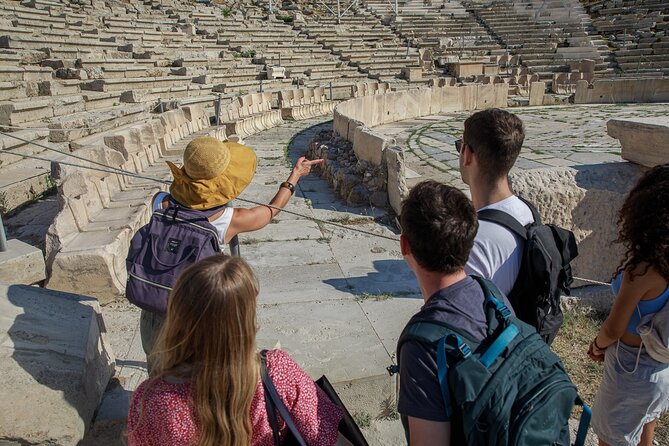
Stop 2: Theatre of Dionysus (about 15 minutes)
The Theatre of Dionysus is where the tour turns myth and culture into something physical. It’s tied to drama—Aeschylus, Sophocles, and Euripides are part of the story—and the point is bigger than theatre trivia. You’re looking at the early stage where Greek culture put on public performances that shaped ideas and identity.
Even if you’re not a drama person, the guide’s job here is to connect the stones to the social world that built them. That’s why a guided tour matters on sites like this: the theatre doesn’t explain itself.
Stop 3: Temple of Asclepios (about 10 minutes)
Next is the Temple of Asclepios, the sanctuary for Asclepius, the god of medicine. This stop feels quieter and more reflective than the big political temples. You’re learning how ancient Athenians thought about healing—spiritual and physical at the same time—and how they gave gratitude when restored health happened.
If Athens feels like a loud city to you, this is the moment that balances the day with calmer energy.
Stop 4: Odeon of Herodes Atticus (about 10 minutes)
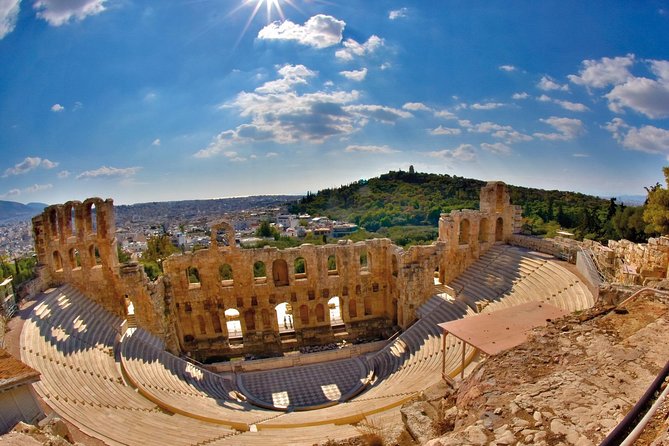
Then you reach the Odeon of Herodes Atticus, a stone theatre still used for performances today. That “ancient meets modern” bridge is real here. The guide’s explanation helps you see why the structure keeps attracting events: it’s not just impressive, it’s usable in a way that many ruins can’t be.
If you’re visiting during concert season, this stop can make you want to book a performance later. Even if you don’t, it adds a modern pulse to ancient space.
Photo pause: Philopappos Hill (Hill of the Muses)
There’s also a designated pause at Philopappos Hill (also called the Hill of the Muses). You see the Philopappos monument, and the real draw is the view over Athens below.
This is one of those “pause, breathe, and recalibrate” moments. It also gives you a break from constant looking down at your feet, which matters on this kind of uneven terrain.
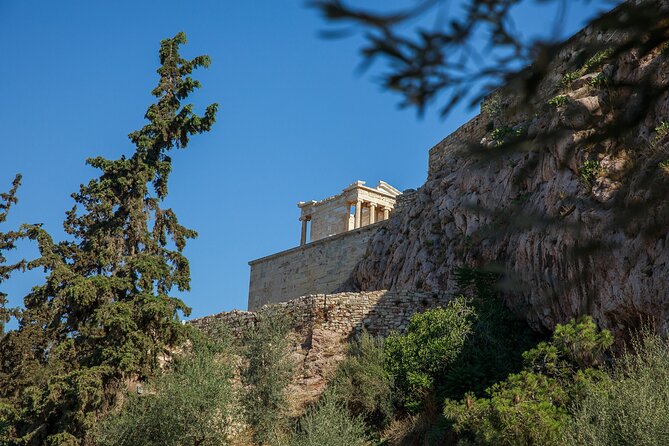
Stop 5: Temple of Athena Nike (about 5 minutes)
The Temple of Athena Nike is small compared to the Parthenon, but the guide makes it meaningful. It sits on a bastion at the southwestern edge of the Acropolis and is dedicated to Athena in her victory role.
This stop is short by design. The guide uses it as a stepping stone—both visually and historically—so you don’t lose the momentum toward the key architectural showpiece.
Stop 6: Propylaea (about 5 minutes)
You pass through the Propylaea, the grand marble gateway. The feeling here is all about arrival. It’s an architectural “threshold,” designed to make you sense that you’re moving into an important space with rules and ritual.
If you’ve ever been disappointed by ruined gateways, you probably won’t be here. The guide’s framing helps you understand the intention even if every detail isn’t fully intact.
Stop 7: Erechtheion with Caryatid Porch (about 15 minutes)
The Erechtheion is where the architecture starts to feel like art. It’s dedicated to Athena and Poseidon, and the highlight is the Caryatid Porch—six female figures that support parts of the structure.
This is a stop that benefits from staying longer than a quick photo. The guide’s explanation makes the sculptures feel like deliberate storytelling, not just decorative stone.
Stop 8: Parthenon finale (about 25 minutes)
The Parthenon takes the longest time for a reason: it’s the centerpiece and the culmination of the route. You’ll see it from angles that help you understand how the temple communicates power and devotion at the same time.
You’ll also hear what the temple represents—dedicated to Athena Parthenos—and how it fits into the classical identity of Athens.
If you take one deep breath during the tour, take it here.
Earsets, crowds, and whether you’ll actually hear the guide
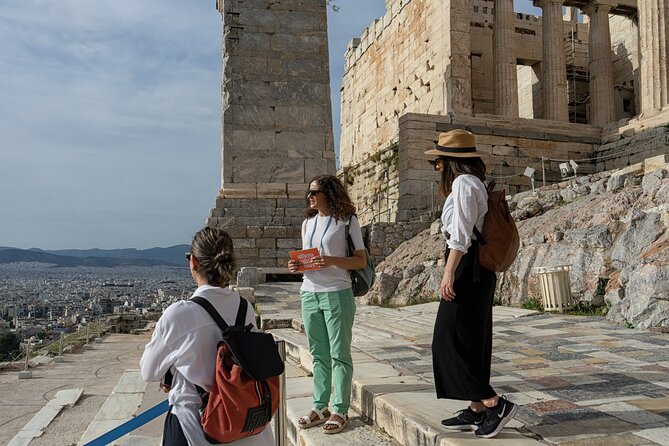
The tour provides earsets for better hearing, and in lots of experiences this is the difference between enjoying the day and feeling like you’re missing half the story.
Still, there are two real-world factors to keep in mind:
- In very crowded areas, you might need to adjust your position to keep your audio clear.
- In windy conditions, sound can get harder to track, and a few people have noted headset/audio issues like intermittent sound or static.
My practical advice is simple: keep your earset snug, protect it from water if it rains, and don’t be shy about raising a hand if you truly can’t hear. A good guide will adjust the group’s movement so everyone can catch the explanation.
Comfort tips that make this Acropolis day easier
You’ll want comfortable walking shoes. The terrain is uneven, and the walk is uphill. A review specifically called out how uneven surfaces can be a factor—so I treat this as a “moderate fitness” outing rather than a stroll.
Plan for the fact that there are no toilets once you’re in the site, so go before you start and keep water handy. The tour advises bringing a bottle of water, plus sun protection like sunscreen and a hat.
One more practical point: baby strollers are not allowed on the Acropolis archaeological site, and there’s no cloakroom on the side entrance used to enter. A baby pouch is recommended if needed.
If you’re sensitive to heat or you’re traveling with seniors, it helps to choose a cooler time of day. The tour is short, but the climb still takes effort.
What you get beyond the temples: the map and guide magazine
This is a small thing that pays off later. You receive an Athens map and an Athens guide magazine filled with ideas for other self-guided stops.
That matters because the Acropolis is just one layer of Athens. After your tour, you’ll likely want to explore neighborhoods, viewpoints, and museums at your own rhythm. Having a map and guide handy helps you avoid the typical “where do we go next” slowdown.
Where this fits in your Athens itinerary

This tour shines when:
- You’re short on time but still want the UNESCO World Heritage core of the Acropolis.
- You want a guided explanation instead of playing archaeologist alone.
- You want a clean structure that gets you from orientation to Parthenon without losing the thread.
If you’re also planning the Acropolis Museum, it can pair well, but the best timing depends on your day. The tour info notes skip-the-line benefits tied to the Acropolis of Athens & Museum ticket offices when you choose the admission-ticket option, so it’s worth planning your overall schedule so you don’t run out of hours.
Who should book this tour
I’d steer you toward this tour if:
- You like stories with your sightseeing, not just photos.
- You want the big hits on the hill in about 2 hours.
- You appreciate clear audio support and a group cap of 24 travelers.
I’d think twice if:
- You have trouble with uphill uneven walking and need long rest breaks.
- You can’t do timed entry pressures, since late arrivals can’t be waited for due to strict entry timing.
- You’re looking for a slow, mostly flat walk where you can linger at every stone without moving.
Should you book the Athens Acropolis and Parthenon Walking Tour?
If your goal is to see the Acropolis and leave understanding what you actually saw, I’d book it. The licensed guide, earsets, and tightly planned hilltop route are exactly the combo that makes the Parthenon area click instead of feeling like a blur of impressive ruins.
Choose the admission-included option if you want the simplest path and a smoother start at the ticket offices. Choose without admission only if you’re comfortable handling your own entry ticket in advance and you don’t mind managing that extra step.
Given the long odds of “I wish I understood more” when visiting on your own, this tour is a strong value for first-timers and anyone who wants the Acropolis explained in real time.
FAQ
Do I need an entrance ticket to join?
You need a valid Acropolis entrance ticket. If you book without the entrance ticket option, you’ll still complete a separate ticket purchase step after booking and before the tour starts.
Does the tour include skip-the-line access?
Skip-the-line at the ticket offices for the Acropolis of Athens and Museum is included if you choose the option that includes the admission ticket.
How long is the walking tour?
It’s about 2 hours.
What’s the meeting point?
The start is at LUKUMAΔΕΣ, Dionysiou Areopagitou 3, Athina 117 42, Greece, near the base of the Acropolis (described as a yogurt bar area). The end is at Acropoli Athens 117 42, Greece.
Are earsets provided for hearing the guide?
Yes. Earsets are provided to help you hear the guide clearly.
Is the walk easy?
It requires moderate physical fitness. Expect uphill walking and uneven surfaces. Comfortable shoes are strongly recommended.
Are there restrooms on the Acropolis site?
No toilets are available once you’re in the site, so plan ahead.
What should I bring?
Bring comfortable walking shoes, sun protection (sunscreen and hat), and water. Dress for the weather, and come prepared for airport-style security screening.
You Might Also Enjoy



More Walking Tours in Athens



More Tours in Athens

More Tour Reviews in Athens
- All Day Cruise -3 Islands to Agistri,Moni, Aegina with lunch and drinks included
★ 5.0 · 4,958 reviews