REVIEW · ATHENS
Athens Highlights and Athenian Riviera Private Driving Tour
Book on Viator →Operated by Tours of Athens · Bookable on Viator
Athens can feel like a blur. This private driving tour strings together the big hits plus a coastal stop, so you learn the city fast without spending your day in traffic. I especially like how the route mixes major ancient landmarks with practical viewpoints, including Lycabettus Hill and the changing of the guard at Parliament.
I also like that the experience is built for limited time: you ride in a Mercedes with A/C, WiFi, and cold water, and you get English narration from the driver. One thing to plan around: you’re not getting a licensed tour guide included inside the sites, since the driver won’t escort you into museums or entrances.
In This Review
- Key Highlights Worth Your Attention
- A 3–4 Hour Athens Primer That Actually Fits Your Schedule
- The Private Ride Setup: Pickup, Comfort, and How the Time Gets Used
- Skip-the-Line and Tickets: What’s Included, What Isn’t
- Lake Vouliagmeni: The Sunken Lake That Feels Like a Year-Round Spa
- Temple of Olympian Zeus (Olympieion): A Building That Took 600 Years
- Kallimarmaro Panathenaic Stadium: Marble, Olympics, and Ancient Sport
- Lycabettus Hill and Hadrian’s Gate: Viewpoint + Roman Wordplay
- Changing of the Guard at Parliament: The Evzones Ritual
- Price and Value: Is $261.80 Per Person Worth It?
- Who This Tour Fits Best (and Who Should Think Twice)
- Should You Book This Athens Highlights and Athenian Riviera Tour?
- FAQ
- How long is the Athens Highlights and Athenian Riviera Private Driving Tour?
- What is the pickup situation?
- Is this tour private?
- What does the vehicle include?
- Does the tour include entrance fees?
- Is skip-the-line service included?
- Do I get a licensed tour guide?
- What does the driver do during the tour?
- What’s the changing of the guard stop like?
- Can I cancel for a full refund?
Key Highlights Worth Your Attention
- Vouliagmeni’s sunken lake: brackish water, fed by underground currents, at a comfortable ~24°C year-round spa temperature
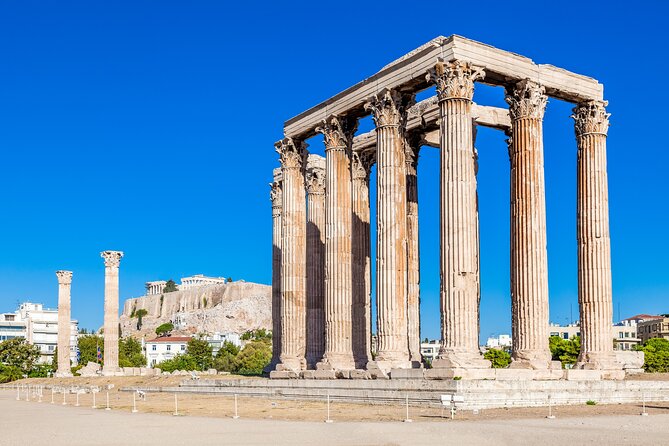
- Olympieion (Temple of Olympian Zeus): a massive temple project spanning centuries, from the 6th century BC to Hadrian in the 2nd century AD
- Kallimarmaro stadium: Athens’ historic marble stadium tied to both the ancient Panathenaic Games and modern Olympics
- Lycabettus Hill: a 300-meter viewpoint with pine trees below and spots like St. George’s Chapel and a theatre
- Hadrian’s Gate: a Roman-style triumphal arch with inscriptions naming Theseus and Hadrian
A 3–4 Hour Athens Primer That Actually Fits Your Schedule
This tour is a smart way to start your Athens trip when you only have a few hours for orientation. You’re not trying to do everything; you’re getting the main map points in one go: ancient religion (Olympian Zeus), ancient sport (Panathenaic Games), Roman Athens (Hadrian’s Gate), and a modern ritual that feels very Greek (Evzones at the Parliament).
What makes it feel efficient is the balance. You get both “wow, that’s ancient” stops and “now I understand where I am in the city” stops. The hill viewpoint and the Parliament ceremony help you connect the dots between the monuments, the neighborhoods, and the daily rhythm of Athens.
You can also read our reviews of more private tours in Athens


The Private Ride Setup: Pickup, Comfort, and How the Time Gets Used
You’ll travel in a Mercedes with air conditioning, plus WiFi on board and mineral cold water. That matters more than it sounds, because Athens sun and walking can stack up quickly. In 3 to 4 hours, you want your energy for the stops, not for heat stress and wasted minutes.
Pickup is offered, so you’re not spending time hunting taxis or figuring out logistics right away. The tour is also private, meaning only your group rides—less waiting around, less negotiating the pace.
One practical consideration: the English-speaking driver provides narration, but they’re not allowed to escort you into sites or museums. So think of this as a drive-plus-stop experience where you do the short site time on your own with pre-arranged access where available.
Skip-the-Line and Tickets: What’s Included, What Isn’t
The tour includes skip-the-line service and pre-purchased tickets, but it also notes that pre-purchased tickets come with an additional cost. That’s common for popular sites: the tour can help you avoid waiting, but some ticketing fees still apply.
Entrance fees aren’t included, so you should expect to pay at least some site costs depending on what’s required for your exact stops. The good news is that a couple key moments are noted as free: the changing of the guard is free, and Lake Vouliagmeni is listed as admission ticket free.
Bottom line: this is a good value if you want speed, and you keep a little cash/credit ready for entrance fees or any pre-purchased ticket add-ons.
Lake Vouliagmeni: The Sunken Lake That Feels Like a Year-Round Spa

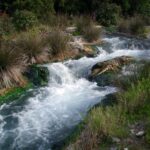
Your first stop is Lake Vouliagmeni, just south of Athens and very close to the sea. It’s called the Sunken Lake, and the reason is geological. You’re looking at a small brackish-water lake that’s fed by underground currents seeping through Mount Hymettus.
The standout detail is the temperature: it sits around 24°C (about 75°F) and functions as a year-round spa. Even if you don’t plan to swim, the idea is cool—this isn’t a seasonal puddle. It’s consistently comfortable.
Time is short here—about 10 minutes—so treat it as a quick mood-setter. You’ll get a coastal-adjacent breather early on, which helps if you’re planning more walking later in the day.
Possible drawback: with only about 10 minutes, you won’t have time for a real soak or long photo session unless your group keeps moving quickly. If you’re a serious beach-and-lake person, you may still want another day out by the Riviera later.
Temple of Olympian Zeus (Olympieion): A Building That Took 600 Years

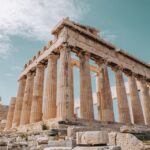
Next up is the Temple of Olympian Zeus, also called the Olympieion, often known through its famous columns as the Columns of the Olympian Zeus. This one hits your brain in two ways: it’s about the ancient gods, and it’s about the long stretch of human ambition.
Construction began in the 6th century BC, during the rule of Athenian tyrants who wanted the grandest temple in the ancient world. It wasn’t completed until Roman times—specifically under Emperor Hadrian in the 2nd century AD, roughly 638 years later.
If you like scale, this is your stop. During the Roman period, the temple was famed as the largest temple in Greece and included 104 colossal columns. It also housed one of the biggest cult statues of the ancient world.
Time here can feel fast, so here’s how to make it meaningful: take a moment to look at the spacing of the columns and imagine a forest of stone. Then connect it to Hadrian, because later you’ll see how strongly Romans reshaped Athens in architecture and branding—especially with Hadrian’s Gate.


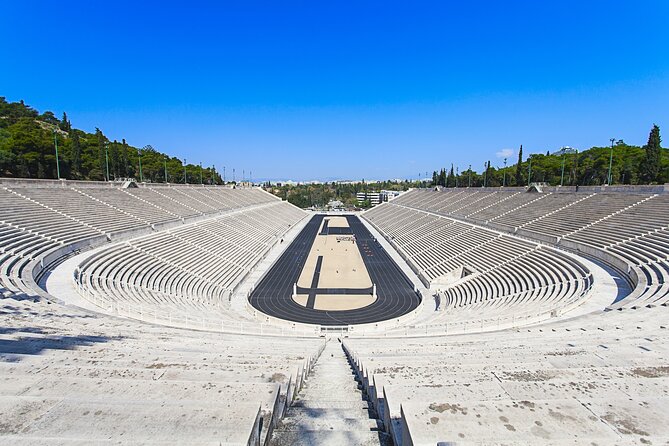
Kallimarmaro Panathenaic Stadium: Marble, Olympics, and Ancient Sport
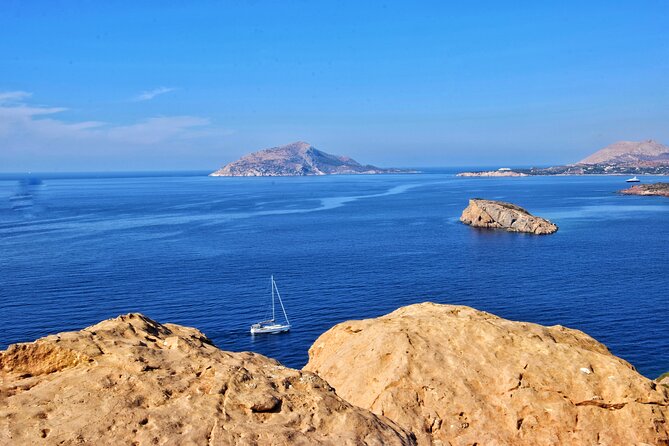
From temple ruins to athletics. The Panathenaic Stadium, known as Kallimarmaro, is one of Athens’ most satisfying sights because it mixes ancient sports tradition with modern Olympic history.
This is the famous point: it’s the only stadium built entirely of marble. That detail alone is worth a stop, but the bigger story is how it kept coming back.
A stadium existed on this site as a racecourse, and later an Athenian statesman, Lykourgos (Lycurgus), built a stadium for the Panathenaic Games around 330 BC. The stadium was excavated in 1869, then hosted the Zappas Olympics in 1870 and 1875.
After refurbishment, it hosted the opening and closing ceremonies of the first modern Olympics in 1896. And it returned again as an Olympic venue in 2004.
Time consideration: since this is a driving tour, you won’t get hours here. But even in a short stop, the marble setting and Olympic echo make the visit feel special. If you’re the kind of person who likes connecting timelines, this is a high-meaning stop in a short window.
Lycabettus Hill and Hadrian’s Gate: Viewpoint + Roman Wordplay
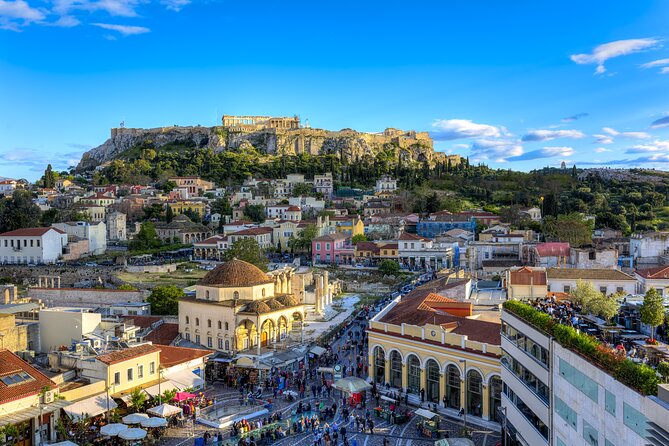
After the stadium, the route turns toward two very different flavors of Athens.
First is Lycabettus Hill (Lycabettos, Lykavittos, or Lykabettos depending on spelling). It rises to 300 meters above sea level. The lower slopes are covered with pine trees, and at two peaks you’ll find the 19th-century Chapel of St. George, plus a theatre and a restaurant.
Even if you don’t climb all the way (the tour time is limited), this stop gives you context. Athens isn’t flat, and this hill is part of why the city feels layered. It’s also a helpful reference point for later sightseeing, because you start to understand where those big views come from.
Second is Hadrian’s Gate, or the Arch of Hadrian. This monumental gateway resembles a Roman triumphal arch. The idea is that it celebrated the arrival of Emperor Hadrian and honored him for his benefactions to the city.
Here’s the clever detail that makes it more than a pretty arch: there were two inscriptions, facing opposite directions, naming both Theseus and Hadrian as founders of Athens. So it’s a Roman message with Greek history in the same frame. You’re basically looking at propaganda that knows how to borrow legitimacy.
Changing of the Guard at Parliament: The Evzones Ritual
Now for a stop that’s pure spectacle. The changing of the guard ceremony happens at the Hellenic Parliament building, and the presidential guards—known as Evzones—guard the Tomb of the Unknown Soldier around the clock, through winter cold nights and summer heat.
The Evzones are an elite unit of the Greek army, and being selected as an Evzone is a high honor. That’s why the ceremony feels more serious than a tourist show. The guards move with a precision that’s hard to fake.
This is listed as about 5 minutes, which sounds short until you factor in how much you learn just watching carefully. The uniforms, the stillness between movements, and the crowd energy create a kind of live museum moment.
Practical tip: bring a light layer if you’re visiting in cooler months, and keep your water ready. Even short ceremonies can feel longer if you’re standing in one spot waiting for a particular moment.
Price and Value: Is $261.80 Per Person Worth It?
At $261.80 per person, this tour isn’t the cheapest way to see Athens. The value comes from what you’re buying: time, private transport, and a route that tackles several major landmarks that normally require separate planning.
Here’s what you get for that money:
- Private Mercedes transport with A/C
- WiFi and mineral cold water
- An English-speaking driver providing narration during the drive
- Pickup offered
- Skip-the-line service, though pre-purchased ticket add-ons may cost extra
- A schedule that includes both ancient Athens and a modern Greek tradition
What you don’t get:
- Entrance fees (not included)
- Lunch
- A licensed tour guide inside sites (bookable upon request)
So who gets good value? People who want a first-pass orientation and don’t want to coordinate buses, taxis, and ticket lines while tired. If you’re traveling in a small group, the “group discounts” can also help reduce the per-person sting.
If you’re a DIY planner who enjoys lots of walking and doesn’t mind figuring transit, then you might spend less alone. But you’ll also spend more time. This tour trades money for smoother logistics—which is exactly what many people want on a first day.
Who This Tour Fits Best (and Who Should Think Twice)
This is best for you if:
- You want an Athens introduction without doing a full-day marathon
- You like having a set order for stops so your photos and impressions make sense later
- You want a mix of ancient ruins, Roman-era architecture, a marble stadium, a viewpoint, and a living tradition
Think twice if:
- You want long, slow museum time or deep interior exploration, since the driver can’t escort you into sites and the visit windows are short
- You’re hoping entrance fees and a licensed guide are fully included, because they’re not
Should You Book This Athens Highlights and Athenian Riviera Tour?
If you want a first-day Athens hit list done efficiently, I think this is a strong choice. The route makes sense, the ride is comfortable, and the stops hit multiple time periods—from Olympian Zeus to Hadrian to the Evzones ritual.
I’d book it if your goal is to get your bearings fast and leave Athens understanding where the big sights fit together. I’d skip it if you prefer slow roaming, long museum time, or all-inclusive guided entry. For most people doing Athens on a tight clock, the private format and the smart mix of stops are exactly the payoff.
FAQ
How long is the Athens Highlights and Athenian Riviera Private Driving Tour?
It runs about 3 to 4 hours.
What is the pickup situation?
Pickup is offered.
Is this tour private?
Yes. Only your group participates.
What does the vehicle include?
You ride in a Mercedes with air conditioning, plus WiFi on board and mineral cold water.
Does the tour include entrance fees?
Entrance fees aren’t included. Some items on the itinerary are marked as free, like Lake Vouliagmeni and the changing of the guard.
Is skip-the-line service included?
Skip-the-line service is included, with pre-purchased tickets noted as having an additional cost.
Do I get a licensed tour guide?
A licensed tour guide is not included. You can book one upon request.
What does the driver do during the tour?
The driver speaks English and provides narration, but they are not allowed to escort you into sites or museums.
What’s the changing of the guard stop like?
You’ll see the Evzones ceremony at the Hellenic Parliament near the Tomb of the Unknown Soldier. It’s listed at about 5 minutes, and it runs around the clock.
Can I cancel for a full refund?
Free cancellation is available. You can cancel up to 24 hours in advance for a full refund, based on local time.
You Might Also Enjoy


More Private Tours in Athens

More Tours in Athens


More Tour Reviews in Athens
- All Day Cruise -3 Islands to Agistri,Moni, Aegina with lunch and drinks included
★ 5.0 · 4,958 reviews