REVIEW · ATHENS
Athens Historical Private Virtual Tour Live Experience
Book on Viator →Operated by Olive Sea Travel · Bookable on Viator
Athens history hits fast when it is live. This private virtual tour keeps it tightly organized, so you see big-name landmarks like the Acropolis and the Temple of Olympian Zeus in about 30 minutes, not a full day. I especially like the interactive Q&A setup, because you can ask what you are actually confused about while you are watching. The other big win is the pacing: it is short enough to fit almost any schedule. One drawback to keep in mind is that, since it is virtual, you will not get the in-person walking pace, smells, and crowds that make Athens feel real.
If you want a quick orientation before a real trip, or you just cannot get to Athens right now, this format makes sense. You also get a mobile ticket and you join from a fixed Athens starting point area—Syntagma Square (Plateia Syntagmatos)—which helps your brain place what you are seeing. It is designed as a private experience for your group only (up to 15), so you are not stuck watching someone else’s headphones and questions.
In This Review
- Key points at a glance
- How the live Athens virtual experience works (and why it is actually useful)
- Syntagma Square to the Parliament: democracy right in the city center
- What you should try to notice here
- Athens University and the National Library: the neoclassical spine of the city
- Possible drawback here
- Mount Lycabettus (Lykavittos) and the panorama trick
- How the tour uses this for real understanding
- Panathenaic Stadium: modern Olympics on ancient ground
- Entering the Acropolis: Parthenon plus the surrounding sacred web
- Propylaea and Pentelic marble: reading architecture like a map
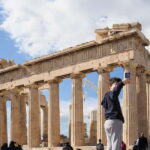
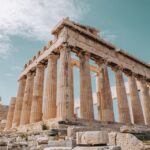
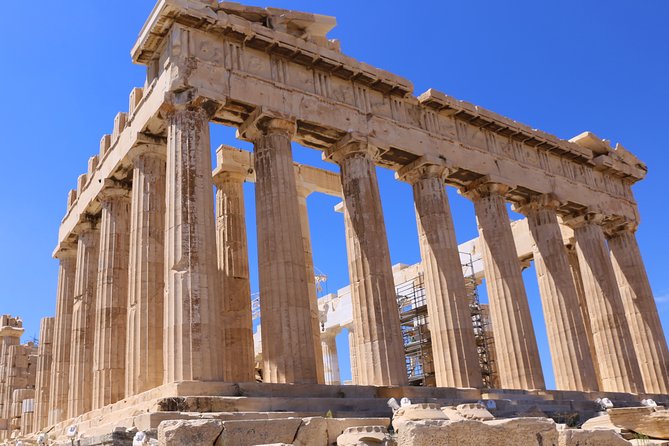
- Parthenon: why people still talk about it
- Odeon of Herodes Atticus and Theatre of Dionysus: Athens as a stage
- A note on the strangest sacred place
- How long you get here
- Temple of Zeus Olympian: Hadrian’s Arch sets the mood
- Value and pricing: $115.64 per group up to 15
- Who this virtual Athens tour suits best
- Practical tips so the tour pays off
- Should you book this Athens private virtual tour?
- FAQ
- How long is the Athens Historical Private Virtual Tour Live Experience?
- Where does the tour start and where does it end?
- Is this a private tour?
- How many people can be in a group?
- Can I ask questions during the tour?
- Is there a mobile ticket?
- Are the sights included in the tour free to enter?
- What are some of the main landmarks you will see?
- Is there free cancellation?
Key points at a glance
- Live guide, on-demand questions: pause your own understanding with real-time answers
- 30 minutes, major highlights: a fast “what to notice” tour over many landmarks
- Syntagma Square starting area: easy reference point for the rest of Athens
- Mount Lycabettus panorama: view-style stops that help you connect the map
- Acropolis essentials: Parthenon plus the surrounding sacred spaces in one run
- Group pricing up to 15: often cheaper per person than you might expect if you fill spots
How the live Athens virtual experience works (and why it is actually useful)
This is a private live session, meaning your group is the only group in the room. That matters because virtual tours can turn into a one-way lecture. Here, you can ask questions throughout, so you can steer the conversation toward what you care about—architecture, Athenian politics, or simply how to read what you are looking at.
The session is short, about 30 minutes. That is not a bug. Athens can overwhelm you with scale and names. A compact tour gives you a clean starting set of landmarks and a few “what to notice” pointers, so when you later see the Acropolis for real (or check out photos on your own), you have a framework.
You also get a mobile ticket. In practice, that means less paperwork and fewer steps than tours that depend on printed vouchers. And since the meeting point is Syntagma Square (Plateia Syntagmatos), you get an Athens anchor. Even though you are online, the guide is still building your orientation around a real location chain.
You can also read our reviews of more private tours in Athens


Syntagma Square to the Parliament: democracy right in the city center
You start near Syntagma Square, then head straight to the Hellenic Parliament area (the Voulí ton Ellínon), which sits in the Old Royal Palace. That building placement is not random. The Parliament is positioned as the supreme democratic institution of Greece, overlooking the central square, so this stop is about more than a pretty façade. It is about how modern Athens visually centers government life.
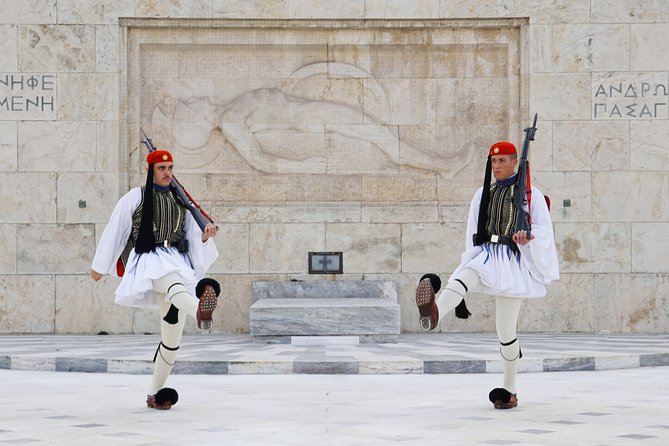
One of the most memorable bits in this part is the changing of the guard in front of the Old Palace, the Euzones. Even if you only catch it briefly online, the key is the idea: these guards are a living tradition tied to how Greeks stage ceremonial presence in public space. It gives you a human moment before the tour shifts back into marble-and-myth territory.
It is also worth paying attention to the tour’s “free admission ticket” angle here. You are not being asked to budget for entry fees as part of this short session. For a virtual format, that may sound minor, but it signals the tour is aiming at recognizable public-area landmarks, not locations that require complicated ticketing to understand.
What you should try to notice here
- How the Parliament building connects to Syntagma Square as a visual focal point
- How the Euzones ceremony acts like a moving “clock” for the area
- How your Athens map starts to form: center first, then higher ground
Athens University and the National Library: the neoclassical spine of the city
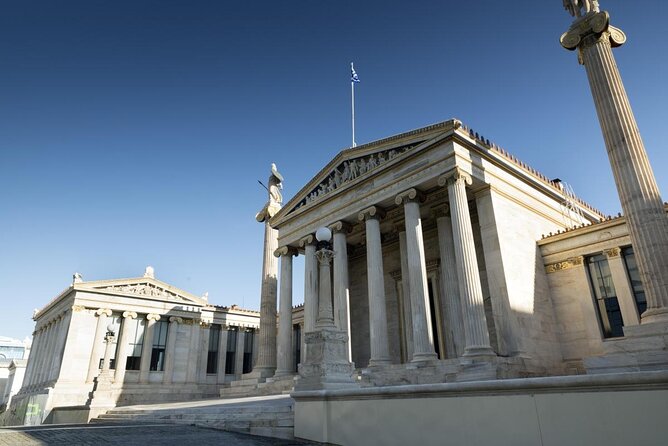
Right after the Parliament stop, you move into a pocket of historic civic buildings: the National and Kapodistrian University of Athens and the National Library of Greece. The university building is designed by Danish architect Christian Hansen and completed in 1864, which is a detail that helps you date the city’s modern institutional identity rather than treating Athens as only ancient.
The National Library is another good anchor. It was built at the end of the nineteenth century, designed by Theophil Hansen. You also hear about how these structures belong to an “architectural trilogy” in Athens that includes the Academy and the University. That “trilogy” concept is helpful because it gives you a mental pattern: Athens did not just rebuild randomly; it created a coordinated look for major intellectual institutions.
The value of these stops in a virtual format is that they break the usual rhythm. Many people expect only Acropolis and nothing else. But knowing that Athens has a strong neoclassical layer gives you context for how the city presents itself now—important if you plan to wander in person later and do not want to feel like you are only chasing ruins.
Possible drawback here
Because the tour is compact, you might want to pause afterward and research the Hansen-designed buildings further. This section gives you names and dates, but it will not replace in-person reading at the sites.
You can also read our reviews of more historical tours in Athens






Mount Lycabettus (Lykavittos) and the panorama trick
Next comes Lykavittos (Mount Lycabettus), the highest hill in Athens. If you have ever looked at photos and wondered how the Acropolis sits relative to everything else, this stop helps. The idea is simple and effective: you go up to the hill, and you get the big-view context—from the hill of Acropolis to the Aegean Sea.
This is one of the most “map-building” moments in the session. Virtual tours often show landmarks like isolated postcards. A panorama stop is different because it explains spatial relationships. It is the difference between memorizing names and actually understanding where Athens is placed.
How the tour uses this for real understanding
- It connects the Acropolis to the surrounding city
- It shows why Athens feels layered: hilltop monuments plus city spreads below
- It helps you picture sightlines before you visit in person
Panathenaic Stadium: modern Olympics on ancient ground
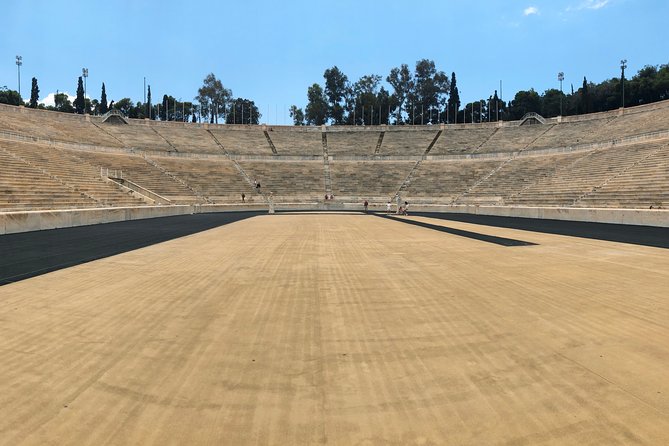
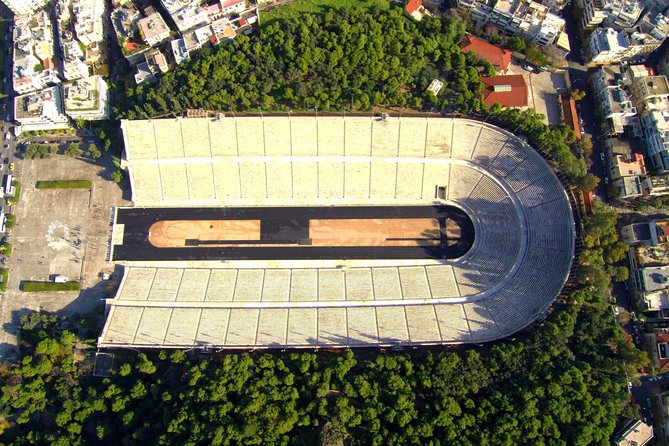
From Mount Lycabettus, the tour visits Panathenaic Stadium. This matters because it is not only “ancient Greece content.” It is a bridge to modern sports history. The first modern Olympic Games were held here in 1896.
In a short virtual session, this stop is smart because it gives you a recognizable landmark that is not only about temples. You get a sense that Athens keeps reusing and re-centering symbols—ancient sites become stages for modern events. That theme is easy to miss if you only focus on the Acropolis.
If you are the type who likes practical context—why places matter today—this is a strong section for you.
Entering the Acropolis: Parthenon plus the surrounding sacred web
Now you get the big one: the Acropolis. The tour frames it as the day’s centerpiece and points you to multiple sites on the hill so you are not stuck looking at one building in isolation.
You are guided through a bundle of key structures:
- the Odeon of Herodes Atticus (a Roman theater structure completed in 161 AD, later renovated in 1950)
- the Temple of Athena Nike
- the Propylaea, the monumental gateway to the sacred area
- the Erechtheum
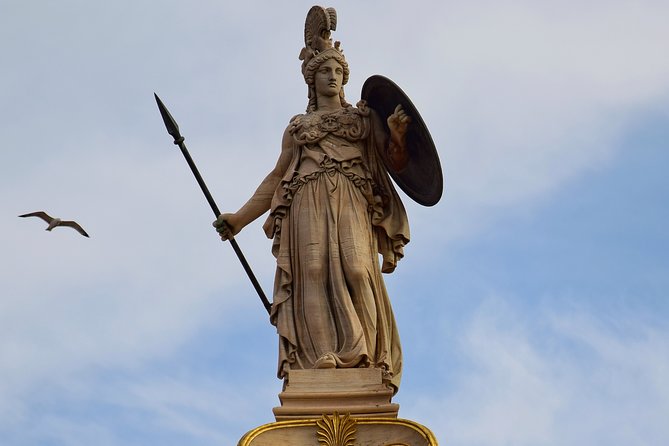
- and, of course, the Parthenon, dedicated to Athena
Propylaea and Pentelic marble: reading architecture like a map
The Propylaea is described as the monumental entrance built by architect Mnesicles using Pentelic marble. The design is called avant-garde in its approach, and the Ionian temple of Apteros Nike is mentioned nearby, currently in restoration. Even without walking the stones yourself, these details help you understand what this space is: not just “cool walls,” but a planned entry sequence into a sacred zone.
Parthenon: why people still talk about it
The Parthenon is presented as the eternal symbol of Athenian democracy and Western civilization. I like that the tour states it plainly. You might hear endless debates about what that phrase means, but as a first orientation, it gives you a direction: this building is tied to civic identity, not only religion or mythology.
Odeon of Herodes Atticus and Theatre of Dionysus: Athens as a stage
You also see:
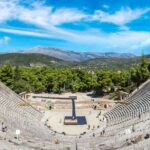
- the Theatre of Dionysus Eleuthereus, considered the world’s first theatre, located at the foot of the Acropolis
- the Odeon of Herodes Atticus, which gives you a second, different type of performance venue
When you connect these, Athens stops being only “temples on a hill.” It becomes an entertainment-and-politics city, where public life, theater, and belief all share space and status.
A note on the strangest sacred place
The tour also calls out the Temple of Poseidon & Athina, described as the strangest and most sacred place in ancient Athens. That kind of wording is a teaser. In a virtual setting, it helps you slow down and pay attention to the idea that the Acropolis is not one single theme; it is a layered set of sacred meanings.
How long you get here
The Acropolis segment is about 10 minutes. That is enough for a guided “tour of the tour” where you learn what to look for. If you want deep architectural analysis, you will still want extra reading or a longer in-person time slot later.
Temple of Zeus Olympian: Hadrian’s Arch sets the mood
After the Acropolis, you head toward the Temple of Zeus Olympian (Tempio di Zeus Olimpio). The guide frames it as the biggest temple in antiquity, devoted to the king of the gods, and you pass by Hadrian’s Arch along the way.
This is another pacing win. If you started Athens with the Parliament and universities, you already saw the modern institutional Athens. If you jumped only to the Acropolis, you might feel the story ends there. This stop stretches it: Athens had massive building ambitions beyond a single hilltop complex.
Value and pricing: $115.64 per group up to 15
The price is $115.64 per group, up to 15 people, and the tour runs about 30 minutes. Think about value in a practical way: the only “fixed cost” is the group session itself. If you have a small group, it can work out reasonably because you are buying access to a live guide and interactive time—not just a recording.
For families or friend groups who want a shared orientation, the per-person cost can drop quickly if you actually fill the group cap. And if you are traveling with limited mobility, the format can be a lifesaver: you get the landmarks without the uphill walking, ticket queues, or weather headaches.
Where it may not be as good value is if you are solo and you only want one person’s worth of attention. The tour is private, but pricing is still per group, so you might compare it to other virtual options that charge per person.
Who this virtual Athens tour suits best
I think it is a strong fit if you:
- want an efficient primer on Athens before booking in-person time
- are constrained by mobility, time, or logistics
- are traveling with someone who benefits from short segments and clear naming
- want a live guide you can ask questions to (not just a slideshow)
It also works if you are building an itinerary and need to decide what to prioritize later. The tour gives you a list of targets (Parliament area, Lycabettus panorama, Acropolis buildings, Temple of Zeus) and explains enough context that you can make smart choices.
Practical tips so the tour pays off
To get more from a 30-minute live session, treat it like a sprint, not background noise.
- Have a map handy (even a simple phone map). When the guide shifts from Syntagma to the Acropolis, you will track the “why.”
- Keep a running list of questions. If something feels confusing—like the role of the Propylaea or what Apteros Nike refers to—ask during the interactive part.
- Choose your viewing setup. A bigger screen helps with names and landmark orientation.
- After the session, pick one stop to follow up. Acropolis architecture is the obvious choice, but Panathenaic Stadium is a great second option if you want variety.
And if you can, go into it with one goal: either understand the layout of Athens, or understand what each monument represents. The tour is built to support that kind of focused learning.
Should you book this Athens private virtual tour?
Book it if you want a fast, well-structured overview of Athens with a live guide and real interaction. The best reason is the combination of short duration and major landmark coverage, especially the Acropolis segment that links multiple buildings into one mental model.
Skip it (or treat it as a starter only) if you expect a long, deep, in-person feeling. This is history at speed, and you will likely want additional time—either in another guided session or with self-guided reading—if you crave details without any time limits.
If you are planning a trip and need to get oriented quickly, this is a smart use of time. You will come away knowing what to look for, where Athens sits in relation to the sea, and why the Acropolis is more than one famous temple.
FAQ
How long is the Athens Historical Private Virtual Tour Live Experience?
The tour lasts about 30 minutes.
Where does the tour start and where does it end?
It starts at Syntagma Square (Plateia Syntagmatos, Athina, Greece) and ends back at the same meeting point.
Is this a private tour?
Yes. It is private, and only your group participates.
How many people can be in a group?
The price is per group for up to 15 people.
Can I ask questions during the tour?
Yes, the experience is interactive and you can ask questions throughout the tour.
Is there a mobile ticket?
Yes, the tour includes a mobile ticket.
Are the sights included in the tour free to enter?
The stops listed in the itinerary show admission tickets as free.
What are some of the main landmarks you will see?
You will cover the Hellenic Parliament area, Mount Lycabettus, Panathenaic Stadium, the Acropolis (including the Parthenon), and the Temple of Olympian Zeus.
Is there free cancellation?
Yes. You can cancel up to 24 hours in advance for a full refund.
You Might Also Enjoy

More Private Tours in Athens


More Tours in Athens




More Tour Reviews in Athens
- All Day Cruise -3 Islands to Agistri,Moni, Aegina with lunch and drinks included
★ 5.0 · 4,958 reviews