REVIEW · ATHENS
Athens City of Rebellion Small-Group Walk
Book on Viator →Operated by Culture Hunters · Bookable on Viator
Modern Athens has a protest pulse. This walking tour traces how rebellion shaped the city, from Ottoman-era clashes to today’s fights for social justice. I loved the small-group size and how the story plays out in real streets, not just big-name monuments.
Syntagma Square and Exarchia make the past feel uncomfortably present. With guide Maelle, the walk turned into a clear, easy way to connect centuries of Greek history, including how 19th-century figures like Lord Byron and the Greek royal family fit into the independence era. The sites are mostly quick stops, so you keep moving and the context stays tight.
One thing to consider: this is a walking-focused tour, and it is not recommended if you have walking difficulties. Also, it depends on good weather, so plan to be flexible.
In This Review
- Key things you’ll notice on this Athens City of Rebellion walk
- Modern Athens Revolution Trail: What This Walk Really Shows
- Monastiraki Square to Tzisdarakis Mosque: Ottoman Athens in One Breath
- Ayìa Dynami Church: Resistance That Used the City’s Hidden Spaces
- Syntagma Square: The Protest Square, the Royal Square, the Occupation Square
- The Tomb of the Unknown Soldier and the Evzones Details
- University of Athens: When Students Become Political Force
- Navarinou Park: Citizen Initiative at the Neighborhood Level
- Exarchia: Athens’ Resistance Epicenter, Past and Present
- Price and Value: Is a $46.29 Walk Worth It?
- Booking, Timing, and Logistics That Matter (and What Doesn’t)
- Who Should Take This Tour (and Who Might Want Something Else)
- Should You Book the Athens City of Rebellion Walk?
- FAQ
- FAQ
- How long is the Athens City of Rebellion small-group walk?
- What’s the group size for this tour?
- Where does the tour start and end?
- Do you need tickets or pay admission during the stops?
- Is the tour good for people with mobility issues?
- What happens if weather is bad or you need to cancel?
Key things you’ll notice on this Athens City of Rebellion walk
- A max-6 small group that keeps the pace thoughtful, not rushed
- Ottoman-to-modern links explained through places you can actually point to
- Syntagma Square’s layers: royal power, wartime occupation, and postwar memory in one area
- Maelle’s guidance focused on context for people who feel lost between classical and modern Greece
- Exarchia as a living neighborhood, with street art and ongoing civic initiatives
- Mostly no-cost site stops, with a mobile ticket for easy entry where needed
Modern Athens Revolution Trail: What This Walk Really Shows
This isn’t a typical Athens history tour that starts with marble and ends at a viewpoint. Instead, you’re walking through the city’s rebellion storyline—who fought, who controlled power, and how ordinary people pushed back when they had little room to breathe.
The value here is that the tour picks moments where Athens changed. You don’t just hear about uprisings as far-away events. You see how the city kept the marks—sometimes in buildings, sometimes in squares, and sometimes in neighborhoods that still carry their political identity today.
You’ll also notice something else: the rhythm. The stops are short, but the explanations are built to connect. That matters in Athens, where it’s easy to hop from one site to another and still feel like you visited a list. Here, you leave with threads you can follow.
You can also read our reviews of more walking tours in Athens


Monastiraki Square to Tzisdarakis Mosque: Ottoman Athens in One Breath

You start at Monastiraki, a classic Athens hub that many people pass through fast. On this walk, it becomes a launching pad. Your guide uses the square to set the tone: Athens has always had a power struggle, and the modern city grew out of those clashes.
From there, you move to the Tzisdarakis Mosque. This stop is a quick one, but it has a big “how did we get here?” payoff. You’ll connect the Ottoman past to the Greek Revolution, and you’ll do a kind of mental time travel—imagining the Acropolis with a minaret during Ottoman rule. Even if you’ve seen the Acropolis a dozen times, that kind of visual helps you understand why the Revolution was not just about politics, but about identity and control of space.
Practical note: this is a short stop, so be ready to absorb quickly and move on.
Ayìa Dynami Church: Resistance That Used the City’s Hidden Spaces
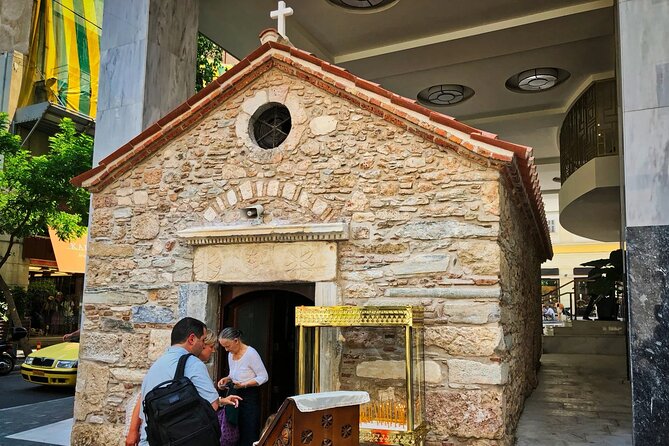
Next up is the Holy Church of the Sacred Power (Ayìa Dynami). This is the kind of stop that changes how you read a city. Instead of treating churches purely as architecture, your guide frames it as a tool during resistance.
You’ll hear how this church was used by members of the Greek resistance during the Ottoman occupation. That detail matters because it shows resistance wasn’t only battles in open spaces. It was also people using the everyday fabric of the city—religious sites, networks, and trusted spaces—to survive and organize.
Even though the stop is brief, it gives you a different lens for Athens. You start spotting the city’s “in-between” places—the ones that aren’t famous but still carry consequences.
Syntagma Square: The Protest Square, the Royal Square, the Occupation Square

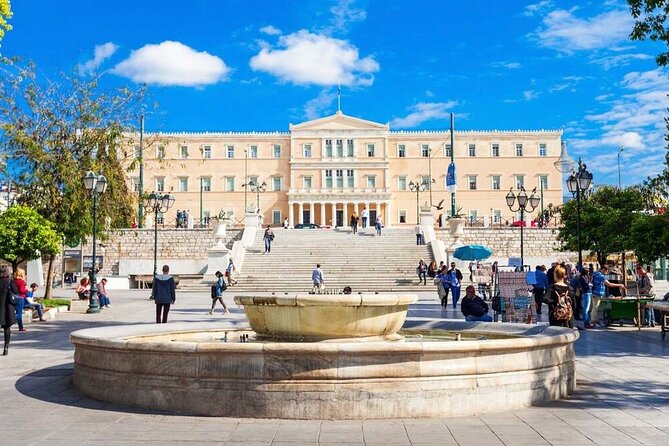
Syntagma Square is the headline stop. It’s also the kind of place that can feel confusing if you only treat it as a location for selfies or flag photos. On this tour, it becomes a layered history lesson.
Here’s what you’ll walk past and talk through:
- The old Palace of the King
- The tomb of the Unknown Soldier
- Nazi headquarters tied to Athens during WWII
- Multiple stories of resistance that unfolded in and around the square
The key is how the tour keeps reminding you that power shifts fast, but memory sticks around. A square can be official one moment and dangerous the next. The city learns to live with that fact.
One of the most striking elements is the contrast you’ll notice nearby: a building now operating as a luxurious hotel, but one with dark moments when Nazis were in power in Athens. It’s not a comfortable contrast, but it’s real. That’s often what makes this tour work so well—it’s not asking you to admire history from far away.
The Tomb of the Unknown Soldier and the Evzones Details
After the square’s broader context, you zero in on the Monument to the Unknown Soldier. This is a short segment, but it has a neat payoff: you’ll learn about the Evzones and their distinctive outfits, and you’ll connect those outfits to the symbolism of guarding the tomb.
Why this matters: it’s easy to think of modern ceremonial details as just pageantry. Your guide helps you see them as national messaging—what Greece chooses to highlight about sacrifice and identity.
If you’re the kind of person who likes the “why” behind traditions, this stop delivers quickly and clearly.
You can also read our reviews of more city tours in Athens






University of Athens: When Students Become Political Force
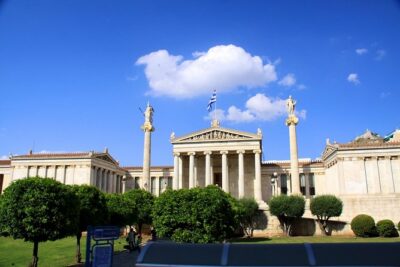
Then you head to the National and Kapodistrian University of Athens. This isn’t one of those stops where you just look at a building and move on. You get the story of how students and universities became a key factor in the fight for citizens’ liberties.
That idea can sound abstract until it’s grounded in a real location. Here, it’s tied to how public debate and political organizing often move through campuses. In Athens, where protest culture has repeatedly intersected with major institutions, this stop helps you connect the dots between earlier resistance and later civic activism.
The timing is also smart. It’s a quick stop in the flow of the walk, so you’re not stuck waiting. You keep momentum.
Navarinou Park: Citizen Initiative at the Neighborhood Level
Next is Navarinou, tied to a unique story: it’s a park shaped by a citizen initiative in the heart of Exarchia’s alternative neighborhood.
This is one of those stops that makes the tour feel more “present tense.” You’re still in the Athens of history, but now you’re also in the Athens of how change gets built—small, local, and often outside official channels.
Even if you’re not sure how Exarchia politics work, this stop gives you a starting point: people don’t just react. They also create spaces and practices that reflect their values.
Exarchia: Athens’ Resistance Epicenter, Past and Present
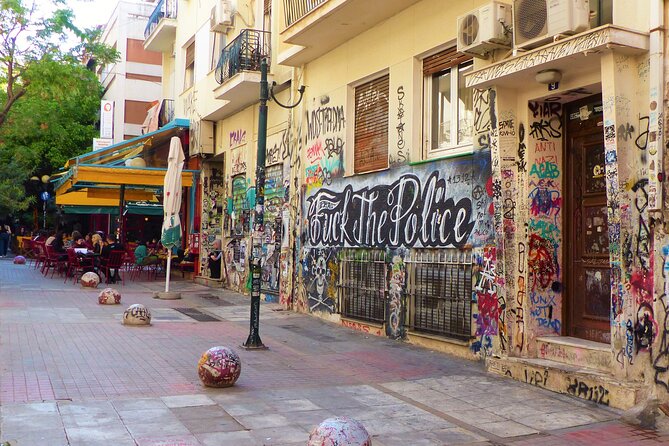
The walk’s final big piece is Exarchia, which your guide frames as the epicenter of today’s resistance. This is where the tour shifts from historical narration into the city as it is right now.
You’ll learn about ongoing issues that shape the neighborhood’s reputation, including:
- crisis
- police violence
- gentrification
And you’ll see and discuss creative responses—street art and citizens’ initiatives—so you get a sense of resistance as more than confrontation. It’s also imagination, community organizing, and identity.
The goal isn’t to package Exarchia as one tidy story. It’s to show how years of rebellion leave a cultural footprint. The neighborhood’s energy is part of why it keeps attracting activists, artists, and outsiders looking for a place to speak and build.
As you walk through it, you’ll also understand why the earlier stops matter. Syntagma Square and the Ottoman-era sites aren’t just ancient chapters. They connect to the idea that Athens keeps renegotiating power.
Price and Value: Is a $46.29 Walk Worth It?

At $46.29 per person, this is a mid-priced walking tour. The value comes from three places:
First, you’re paying for a tight narrative across modern Greek history, not just for a sequence of stops. The tour is about context—how Ottoman control, independence politics, WWII occupation, student activism, and today’s street-level activism connect.
Second, the group is small: max 6 people. That usually means you’re more likely to actually ask questions and keep your attention on the guide’s explanations instead of shouting across a large crowd.
Third, the tour is timed right. At about 2 hours 30 minutes, you get enough coverage to feel you learned something real, but it doesn’t swallow your entire day.
If you’re trying to balance a visit to classic Athens attractions with something that explains modern Greek society, this tour is a strong use of time.
Booking, Timing, and Logistics That Matter (and What Doesn’t)
This tour uses a mobile ticket, which is handy when you’re bouncing between neighborhoods. It’s also close to public transportation, so you can reach the start area without needing a taxi.
You’ll meet at Pl. Monastirakiou 2, Athina 105 55, Greece, and end at Themistokleous 68, Athina 106 81, Greece, near Exarchia Square. That ending spot is useful: it drops you right where the tour’s main theme continues after the walk.
The duration is about 2 hours 30 minutes. Most people can participate, but it’s not recommended for travelers with walking difficulties. And it requires good weather—so it’s smart to check the forecast and have a backup plan if rain shows up.
Who Should Take This Tour (and Who Might Want Something Else)
This is ideal if:
- you want Athens explained beyond ancient sites
- you feel a little lost between classical Greece and modern Greek politics
- you like tours with clear storytelling and short, focused stops
- you’re curious about how resistance culture shows up in neighborhoods like Exarchia
The guide—Maelle—has a reputation for a refreshing, friendly approach and for giving lots of context. If you enjoy figuring out how famous names connect to the big historical shifts, you’ll likely appreciate the way she brings those threads together. (That includes questions like where the Greek royal family fits after independence, and how Lord Byron’s era connects to the independence movement.)
You might want to skip it if:
- you cannot do extended walking
- you strongly prefer purely ancient archaeology and skip modern politics entirely
- you need a tour that stays away from current social tensions (since Exarchia is discussed in real terms)
Should You Book the Athens City of Rebellion Walk?
Yes, if your goal is to understand Athens as a living political city, not just a photo-friendly one. This walk earns its place because it links eras—Ottoman occupation, Greek independence, WWII occupation, student activism, and today’s neighborhood resistance—without turning it into a lecture.
Also, the small group size and Maelle’s guidance make it easier to follow. You come away feeling like you understand why certain squares and neighborhoods have their reputations.
If you only have time for one “modern Athens” experience, this is a strong pick. Just make sure your day allows for walking and that the weather looks decent.
FAQ
FAQ
How long is the Athens City of Rebellion small-group walk?
It runs for about 2 hours 30 minutes.
What’s the group size for this tour?
The tour is limited to a maximum of 6 travelers.
Where does the tour start and end?
It starts at Pl. Monastirakiou 2, Athina 105 55, Greece, and ends at Themistokleous 68, Athina 106 81, Greece, near Exarchia Square.
Do you need tickets or pay admission during the stops?
The stops listed are free, and the tour uses a mobile ticket.
Is the tour good for people with mobility issues?
It’s not recommended for travelers with walking difficulties, though most travelers can participate.
What happens if weather is bad or you need to cancel?
The experience requires good weather. If it’s canceled due to poor weather, you’ll be offered a different date or a full refund. Free cancellation is available up to 24 hours in advance for a full refund.
You Might Also Enjoy


More City Tours in Athens
More Walking Tours in Athens



More Tour Reviews in Athens
- All Day Cruise -3 Islands to Agistri,Moni, Aegina with lunch and drinks included
★ 5.0 · 4,958 reviews