REVIEW · ATHENS
“Tour of Ancient Corinth:Follow in the footsteps of Apostle Paul”
Book on Viator →Operated by Greece Athens Taxi GAT · Bookable on Viator
Corinth is where Greece turns into a Bible map. This private half-day trip connects the Isthmus, ancient ruins, and the climb-worthy fortress of Akrokorinthos with clear, story-driven context and smooth transport.
I like that you get hotel pickup and a comfy, A/C ride with WiFi and bottled water. I also like the “right pace” setup: you’re not stuck on a mega-bus schedule, and the stops are timed so you can actually read the place and ask questions. One thing to consider: the driver shares history, but they’re not a licensed museum/site guide, and ticket prices for archaeological stops are generally not included (the museum has a specific listed fee).
In This Review
- Quick hits before you go
- Why Corinth, and why this route works
- Getting from Athens: pickup, comfort, and why timing matters
- Stop 1: The Isthmus of Corinth and the Hexamilion wall
- Stop 2: Ancient Corinth (Archaia Korinthos) in 30 minutes
- Archaeological Museum of Ancient Corinth: artifacts, sanctuaries, and time travel
- Apollo’s Temple and the ancient market area: what remains (and what it meant)
- Akrokorinthos: the steep fortress with Paul-related story markers
- Drivers, not licensed guides: how to get the best explanations
- Price and what you truly get for $204.50
- When to go and how to plan your day
- Who this tour fits best (and who might want a different pace)
- Should you book this Ancient Corinth: Follow in the footsteps of Apostle Paul tour?
- FAQ
- How long is the Ancient Corinth tour?
- Is this tour private?
- Do you get hotel pickup?
- Is transportation provided?
- Is there a licensed tour guide during museum visits?
- Are tickets included in the price?
- Does the tour help with skip-the-line tickets?
- Where does the tour pick up from at Port Piraeus?
- When is the Archaeological Museum of Ancient Corinth closed?
- What’s the cancellation policy?
Quick hits before you go
- Private, so you set the tone with a dedicated driver and your group only
- Hassle-free pickup from many places around Athens and Port Piraeus
- A focused route that hits Corinth’s key zones instead of only the most basic highlights
- Skip-the-line help for ticket purchasing (you pay the ticket cost)
- Akrokorinthos fortress views from a steep rock that controlled the isthmus
- Museum stop worth planning time for since it covers periods from prehistoric to Byzantine
Why Corinth, and why this route works
Corinth sits on the narrow strip of land that links central Greece to the Peloponnese. In other words, it’s not just a cool ruin field—it’s a strategic choke point. That’s why armies cared, merchants benefited, and ideas (including early Christian messages) traveled through.
This tour leans into that reality. You don’t just wander around one site; you follow a logic: start with the isthmus geography, move into ancient Corinth’s core, spend real time in the Archaeological Museum of Ancient Corinth, then finish with Akrokorinthos—the high fortress that watched over everything below.
If you like learning how places actually functioned—roads, defenses, sacred spaces—this route feels natural. And because it’s private, you can slow down for questions or speed up when you’re already familiar with the basics.
You can also read our reviews of more tours and experiences in Athens.

Getting from Athens: pickup, comfort, and why timing matters
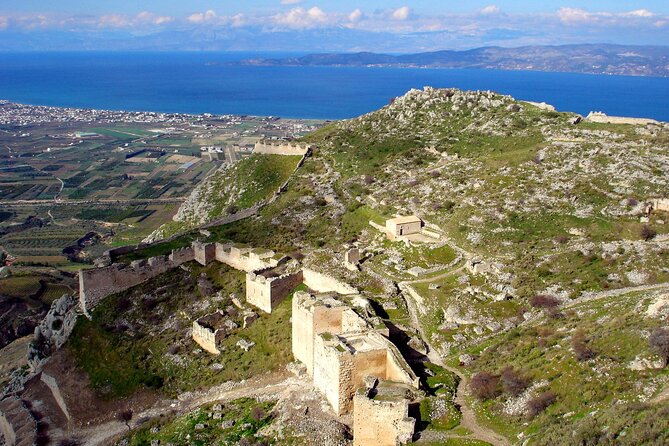
The big value here is how painless the transportation is. You can be picked up from a hotel/Airbnb or directly at Port of Piraeus (with a sign and your name), and you’ll be dropped off at the end without extra charge—assuming you’re in the standard pick-up/drop-off zone.
Inside the vehicle, you’ve got A/C, WiFi, bottled water, and even mobile chargers. If you’ve ever tried to power your phone while hunting for tickets and directions in Greece, you’ll appreciate that. Child seats are available too, which can make a huge difference for families.
The tour runs about 4 to 5 hours total. That’s long enough to feel like a real excursion, but short enough that you don’t lose the whole day to logistics.
One more practical note: the museum is included as a planned stop with a full hour. If you’re the kind of person who likes to read labels and connect artifacts to the sites outside, you’ll be glad it isn’t rushed.
Stop 1: The Isthmus of Corinth and the Hexamilion wall
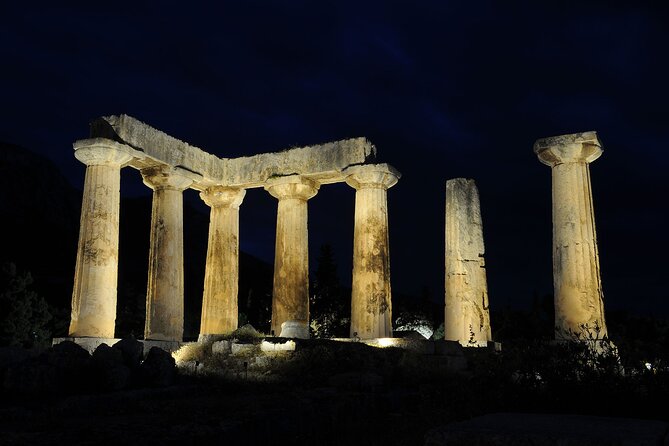
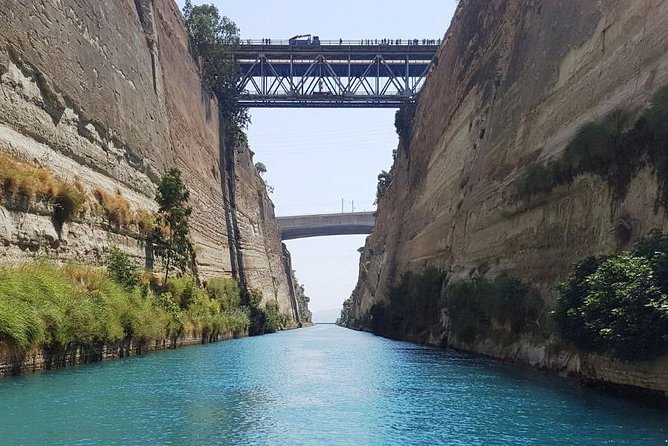
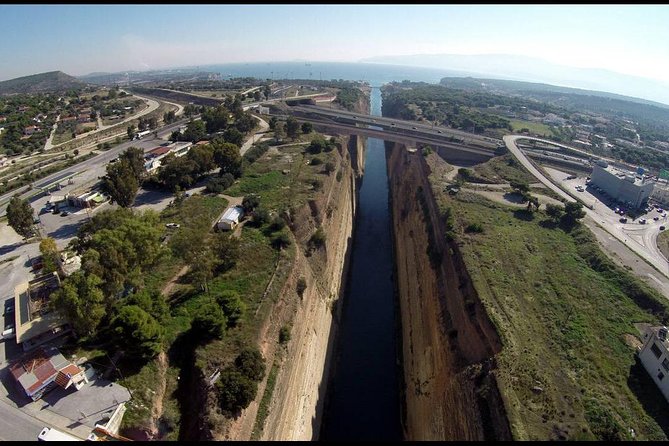
You start at the Isthmus of Corinth, the narrow connector between mainland Greece and the Peloponnese. Today, people often think of the Corinth Canal, but the location matters even more than the modern waterway.
This strip is about 6 kilometers long, and the canal—built from 1880 to 1893—became the modern “tight passage” through the region. In ancient times, the same idea applied: control the narrowest route, and you control movement.
Here’s what I’d pay attention to in this stop: the tour connects the geography to defense. A wall was built in antiquity (end of the 5th century BC), and the line called Hexamilion was preserved into Byzantine times. Translation: this area kept its military importance across many eras.
Time on this stop is about 30 minutes, and the tour details list admission as free. That makes it a great warm-up. You get the map in your head early, so the rest of the day makes more sense.
Stop 2: Ancient Corinth (Archaia Korinthos) in 30 minutes
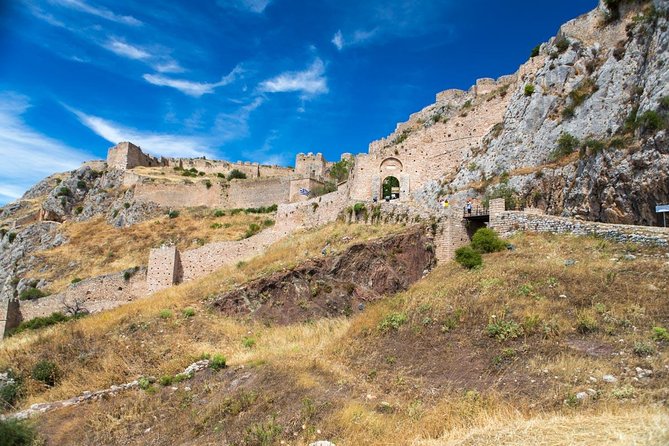
Next comes the ancient city zone called Archaia Korinthos. Corinth was a polis, a city-state, set right on the isthmus. The modern city sits only a few kilometers away, so you’re looking at a place that still feels “alive,” even though it’s archaeology now.
The tour highlights that systematic excavations have been ongoing since 1896 through the American School of Classical Studies at Athens, with additional discoveries by the Greek Ministry of Culture. The practical payoff for you is that Corinth isn’t a static museum of ruins. It’s still being studied, and that’s part of why you can see different layers and understand why new finds matter.
You get about 30 minutes here, and again admission is listed as free. In that short window, I’d focus on:
- getting your bearings first (where the city’s core would have been)
- noticing how the setting on the isthmus shaped daily life
The only potential drawback is also obvious: 30 minutes won’t satisfy someone who wants an all-day excavation tour. But as the second stop in a tight route, it works like an orientation compass.
Archaeological Museum of Ancient Corinth: artifacts, sanctuaries, and time travel
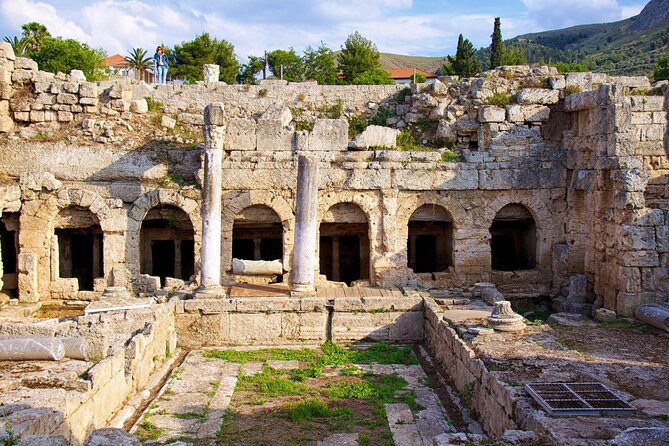
The Archaeological Museum of Ancient Corinth is where the day shifts from outside ruins to inside evidence. It’s located at the archaeological site itself and was built in 1932 by the American School of Classical Studies that conducted the excavations.
You’ll have about 1 hour here. Admission is not included, and the tour lists the fee as €20 per person.
What makes this museum stop stand out is the range of materials it covers. The tour details say you’ll see:
- Prehistoric collections
- finds connected to the Asklepieion (the healing sanctuary)
- artifacts from the Geometric period through to the Byzantine period
- the museum Atrium
- and a named highlight: the Twin Kouroi from ancient Tenea, described as an exquisite sample of archaic plastic art
Even if you’re not a “museum person,” this stop can be worth it because it ties the ruins outside to real objects. And if you’re connecting Corinth to early Christian history, you’ll often find that the healing cult and civic life help explain why people in Corinth talked about faith, body, health, and community in the first place.
If you have limited museum energy, aim to look for what connects sanctuaries and everyday city life, not just one category of objects. One hour is enough if you keep that focus.


Apollo’s Temple and the ancient market area: what remains (and what it meant)
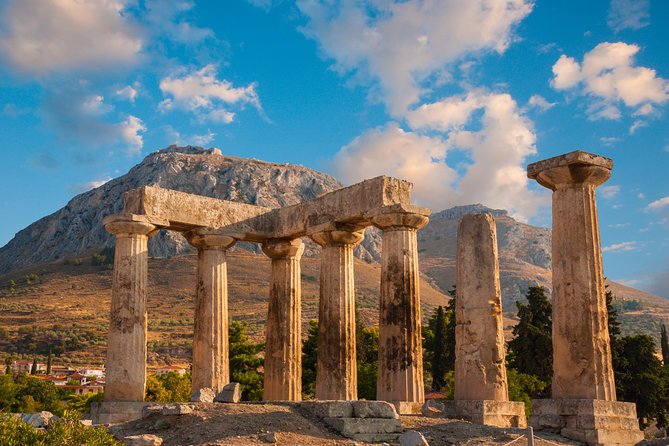
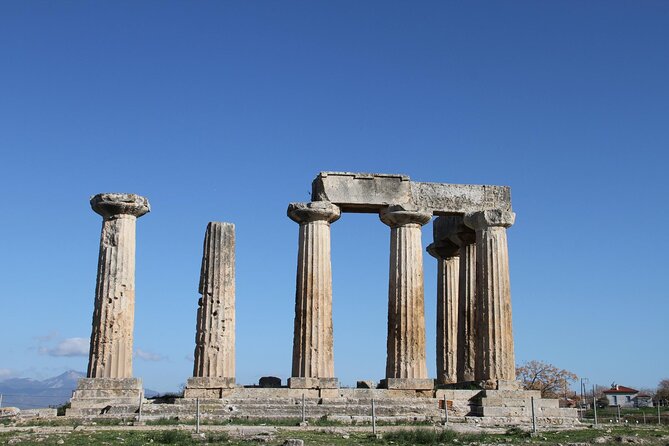
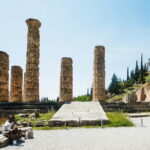
The next portion centers on Corinth’s Temple of Apollo—described as being built of 40 monolithic Doric columns, with only seven still maintained over the ruins of the ancient market.
That’s a striking image: you’re not just looking at “a temple,” you’re looking at the footprint of major civic and religious power. The original temple dates from between the early 7th and early 6th century BC. It was built of stone, bricks, and wooden beams, with a four-pitched roof using clay tiles.
The tour also notes something I think helps visitors: the temple was probably a simpler construction at the time, potentially without external columns, even though later expectations might make you imagine a more crowded, column-heavy exterior. That’s exactly the kind of detail that keeps the site from feeling like generic ruins.
Then the route includes nearby religious context:
- Asklepieion, the healing sanctuary
- Corinth as a Roman colony
- and the museum’s Atrium area (as part of the broader stop)
A practical consideration: these areas are archaeological and can involve uneven ground. Wear shoes you trust. Also, since archaeological tickets aren’t included across the board, build a little extra time (and budget) for ticket checks and entrance timing.
Akrokorinthos: the steep fortress with Paul-related story markers
Now for the main dramatic finish: Akrokorinthos, the high rock fortress rising about 575 meters above the city. It’s described as a monolithic rock and, importantly, it worked as a long-range viewpoint in ancient times—especially during raids.
Here’s why this matters: with its secure water supply, the fortress could hold out and act as a last line of defense. It controlled the Isthmus of Corinth, which means it wasn’t just symbolic. It was functional geography—survival tied directly to who could approach the peninsula.
The tour notes that one assessment calls it the most impressive acropolis on mainland Greece. Even if you’re not chasing superlatives, the viewpoint does the job fast. On a clear day, you’ll feel how Corinth’s position mattered.
Akrokorinthos is also where the tour explicitly references Apostle Paul. It includes an Apostle Paul’s step stop—use that as your cue to slow down and connect the story marker to what you can see: the city below, the strategic passage beyond.
Other points on this hill include:
- Amphitheater
- Theater
- Sanctuary of Asclepius
- Sanctuary of Demeter and Koris
- Fountain Glavki
- Temple of Apollo
- Temple of Octavia
- Early Christian basilicas: Basilica of the Skull and Basilica of Lechai
- plus areas listed as Pirine, Conservatory
The time here is about 1 hour, and entrance tickets are not included. In that time, don’t try to “do everything.” Instead, pick 2–3 areas to focus on. If you’re trying to connect early Christian history to earlier religious traditions, the basilicas plus the sanctuary references create a strong storyline.
One caution: Akrokorinthos is steep by nature. The tour says most travelers can participate, but if you have mobility limitations or hate uneven steps, you should think carefully and plan for shorter, slower pacing.
Drivers, not licensed guides: how to get the best explanations
This tour is built around an English speaking driver with knowledge of history. The driver is helpful, but they’re also explicitly noted as not licensed to accompany you in any site. Translation: you’ll get context and narrative from the vehicle and during transitions, but you should expect that museum explanations and site commentary may be more informal than a licensed guide inside every exhibit space.
That said, this setup can work really well. One driver name that comes up is Andreas, praised for being polite, knowledgeable, and going above and beyond for comfort. Others include Spyros and Ted, both described as conversational and well-balanced with the right amount of detail.
How you can make this work for you:
- Ask for a quick “what should I notice first” at each stop.
- If there’s a topic you care about—Paul, the healing cult, Roman Corinth, fortifications—tell the driver early.
- Use the time between locations for the story-building parts. That’s usually where drivers shine, because they aren’t limited by exhibit rules.
Also, the tour provides mobile chargers and WiFi on board, which helps you keep momentum instead of stopping to search for charging outlets or downloading maps at the last second.
Price and what you truly get for $204.50
The price is $204.50 per person for a private experience lasting about 4 to 5 hours.
What you’re paying for isn’t just “transport.” You’re paying for:
- private transportation in an A/C Mercedes-Benz
- hotel/Airbnb/Port of Piraeus pickup and drop-off without extra charge
- WiFi, bottled water, and mobile chargers
- a driver who can narrate the history in English
- help with skip-the-line ticket purchasing (you cover the actual ticket costs)
Now the cost reality check: archaeological tickets are generally not included. The tour lists the Archaeological Museum of Ancient Corinth as €20 per person. It also states admission is free for the Isthmus of Corinth and for Ancient Corinth (Archaia Korinthos).
So your total out-of-pocket will depend on what’s required for Akrokorinthos and other areas you enter. But the pricing logic still feels fair if you value comfort, time efficiency, and not having to figure out transport between spots on your own.
If you’re splitting costs with a friend or traveling as a small group, private tours like this can start looking like the better deal compared with cobbling together multiple public legs—especially when you’re only in Athens for a short window.
When to go and how to plan your day
This tour is often booked about 39 days in advance on average, so if your dates are tight, don’t wait.
Seasonal planning matters most for the museum and ticket pricing. The tour notes ticket prices vary depending on season (winter vs summer). It also lists museum closure dates:
- January 1
- March 25
- May 1
- Easter Sunday
- December 25
- December 26
If you’re traveling around those, you’ll want a plan B for the museum component.
Also, consider how you’ll manage heat. Even outside peak summer, you’ll be outdoors for multiple stops plus the hill at Akrokorinthos. A/C in the vehicle helps, but sunscreen and a hat still win.
Who this tour fits best (and who might want a different pace)
This experience is a strong match if you want:
- a private day with a dedicated vehicle and pickup
- a route tied to Apostle Paul’s world, including Akrokorinthos story markers
- a balance between outside sites and museum time
It’s also useful if you hate rushing. The structure gives you a sensible arc: geography → ancient city → museum evidence → fortress overview.
It may not be ideal if you want a fully licensed, deep-dive tour guide inside every museum room. Since the driver isn’t a licensed museum/site guide, you might prefer an option that explicitly includes a licensed guide throughout the exhibits.
If you’re traveling with kids, the presence of child seats is a real plus. If you’re traveling with a service animal, the tour says service animals are allowed.
Should you book this Ancient Corinth: Follow in the footsteps of Apostle Paul tour?
Book it if you want a clean, comfortable way to connect Corinth’s strategic geography with its sacred spaces and the Apostle Paul touchpoints—without the hassle of public transport and without a rigid big-group pace.
Skip or compare if:
- you’re extremely price-sensitive and want everything ticket-included
- you want a fully licensed guide inside every stop (this is driver-led history, not a licensed guide everywhere)
- you don’t handle steep terrain well (Akrokorinthos is a high rock fortress)
My take: this is good value for the effort it saves you. If you care about context—why Corinth mattered, not just what it looked like—you’ll get your money’s worth in how the stops connect.
FAQ
How long is the Ancient Corinth tour?
The tour lasts about 4 to 5 hours.
Is this tour private?
Yes. It’s a private tour/activity, with only your group participating.
Do you get hotel pickup?
Yes. Hotel/Airbnb/Port Piraeus pickup and drop-off are included without extra charge. Rafina Port and Laurio Port pickup/drop-off have an additional charge.
Is transportation provided?
Yes. You get private transportation in an air-conditioned Mercedes-Benz vehicle, with WiFi, bottled water, and mobile chargers.
Is there a licensed tour guide during museum visits?
No. The driver speaks English and has knowledge of the history, but they are not licensed to accompany you at any site or museum.
Are tickets included in the price?
Not fully. Ticket costs for archaeological places and museums are generally not included. The Archaeological Museum of Ancient Corinth has a listed fee of €20 per person. The Isthmus of Corinth and Ancient Corinth are listed as free admission in the tour details.
Does the tour help with skip-the-line tickets?
Yes. There’s assistance with purchasing skip-the-line tickets, but you cover the ticket cost.
Where does the tour pick up from at Port Piraeus?
It meets you right outside your cruise ship with a sign displaying your name.
When is the Archaeological Museum of Ancient Corinth closed?
It’s closed on January 1, March 25, May 1, Easter Sunday, December 25, and December 26.
What’s the cancellation policy?
Free cancellation is available up to 24 hours in advance for a full refund. Canceling less than 24 hours before the start time isn’t refunded.
You Might Also Enjoy
More Tours in Athens


More Tour Reviews in Athens
- All Day Cruise -3 Islands to Agistri,Moni, Aegina with lunch and drinks included
★ 5.0 · 4,958 reviews