REVIEW · ATHENS
Athens Half-Day Tour: Acropolis, Parthenon & All Major Landmarks
Book on Viator →Operated by Greek Heritage: Private Tours & Transfers · Bookable on Viator
Ancient Athens in five hours feels like cheating. What makes this outing fun is the fast, organized hop between classics and city-center landmarks, all while staying comfortable in an air-conditioned vehicle with front-door pickup. I like the clear, stop-by-stop setup your driver gives you before you head in, so you’re not just standing there at the Parthenon thinking What am I looking at? I also like that the itinerary is structured enough to cover a lot without making you feel yanked around. One thing to consider: tickets aren’t included and the driver isn’t allowed to accompany you inside sites, so you’ll manage entrance lines and your own museum time.
This is priced at $145.12 per person for about 5 hours, which is really a payment for private transport, door-to-door convenience, and an English-speaking driver with deep historical context (not a licensed site guide inside). If it’s your first day—or you only have a half-day—this “greatest hits” approach helps you see major landmarks and still leave room to return later for anything you loved most.
In This Review
- Key things that make this tour work
- How the 5-hour private format keeps Athens from melting you
- Acropolis and Parthenon: what you should look for in your 30-minute window
- Plaka and Alexander’s Athens: history moving under your feet
- Hadrian’s Arch and the Roman line you can actually trace
- Syntagma Square: Parliament, the Unknown Soldier, and a real-world Athens pause
- Panathenaic Stadium and the Athenian Trilogy: marble, education, and civic pride
- Temple of Olympian Zeus and the scale lesson
- Optional upgrades: Acropolis Museum vs. Ancient Agora (and how to choose)
- The Acropolis Museum option
- The Ancient Agora option
- How I’d choose
- Price and logistics: what you’re paying for, and what you still have to handle
- Comfort, timing, and small habits that make the day smoother
- Should you book this Athens half-day tour?
- FAQ
- Is the tour guided inside the major sites?
- Are entrance tickets included?
- How long is the tour?
- Does the tour include pickup and drop-off?
- What language is the tour offered in?
- Can I add the Acropolis Museum or the Ancient Agora?
- Can I cancel for a refund?
Key things that make this tour work

- Private vehicle comfort: Air-conditioned ride plus bottled water, which matters in Athens heat.
- Driver-led context (without inside escort): You get historical framing, then you explore the sites yourself.
- Acropolis + Parthenon time blocks: Short but focused visits designed for maximum skyline views.
- Syntagma Square and monuments: Stops around Parliament and the Tomb of the Unknown Soldier add a modern Athens layer.
- Academic Athens in one route: The Academy, University, and National Library let you see the Athenian Trilogy area quickly.
- Optional add-ons: You can expand to include the Acropolis Museum or the Ancient Agora for a fuller story.
How the 5-hour private format keeps Athens from melting you
Think of this as a “guided transport + smart pacing” half-day. You’re in a private group, and pickup and drop-off come from basically anywhere in Athens (the driver arrives about 5 minutes early). That alone can save you from the usual city-day chaos of finding meeting points, guessing where parking is, and trying to route yourself under time pressure.
The schedule is built around quick orientation stops and short site windows:
- Acropolis Hill and the Parthenon are each about 30 minutes on site.
- Several city-center landmarks get 10–15 minutes apiece.
- You also have optional time switches later for the Acropolis Museum or the Ancient Agora.
For most people, that timing is ideal when you want big payoff without committing a full day. If you’re the type who likes to sit and read every sign slowly, you’ll still enjoy it, but you may want one of the optional add-ons (or plan to return).
One practical tip I love: download WhatsApp for smoother communication. If you’re ready to move on early—or you want an extra few minutes—being able to message your driver helps keep the day from feeling rigid.
You can also read our reviews of more tours and experiences in Athens


Acropolis and Parthenon: what you should look for in your 30-minute window
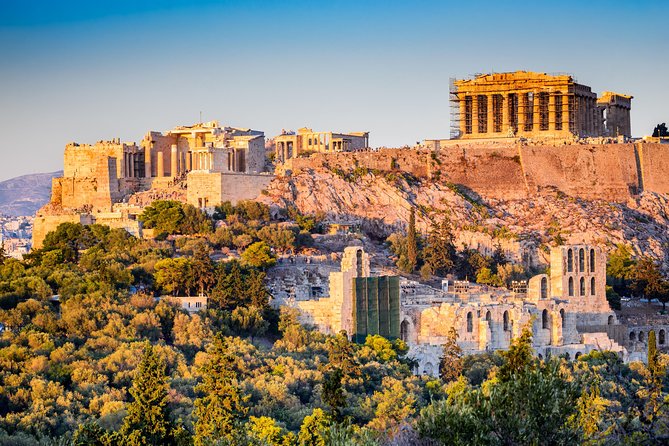
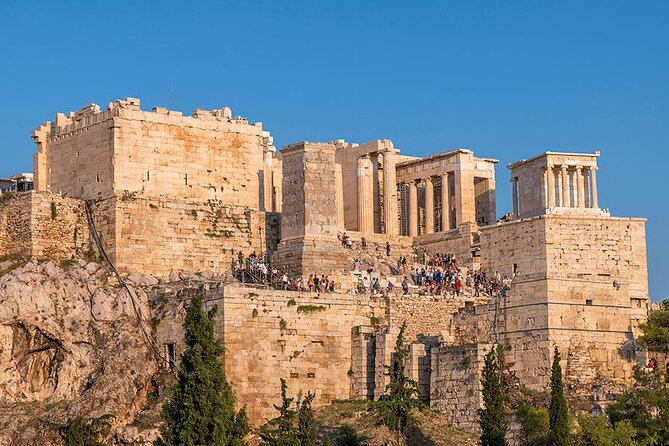
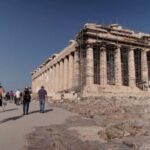
The Acropolis is the headline in Athens for a reason. It’s a high, dramatic citadel and a UNESCO World Heritage site, with a lineup of structures that define Classical Greek architecture. During your stop, you’ll be close enough to absorb the scale and the views, even if you don’t have hours to wander.
Your time here is short, so you’ll get the most out of it if you go in with a simple game plan:
- Start with the big shapes: Doric columns, strong symmetry, and that “city above the city” feeling.
- Notice the key buildings mentioned for the ensemble: the Propylaea, the Erechtheion, and the Temple of Athena Nike.
- Use the elevation for context. The skyline view makes the site’s purpose clearer than any photo.
When you move to the Parthenon, it’s all about recognizing why this temple became a symbol. Dedicated to Athena, it was built between 447–432 BCE and designed with Classical precision: a rectangular plan, 46 outer Doric columns, and a frieze packed with mythological scenes. Even with centuries of damage and reconstruction, the proportions are still impressive in person.
One more thing: tickets are not included. You’ll need to pay for the Acropolis Hill admission (€30 per person) separately, and lines can be real. If you can, pre-order tickets a few days before you arrive at hhticket.gr. It can make the start of your Acropolis time feel less stressful.
If your goal is to leave Athens with images and context that actually connect, this Acropolis + Parthenon pairing is the right way to do it in a short visit.
Plaka and Alexander’s Athens: history moving under your feet
Not every stop here is about stone temples. Plaka is different—more lived-in, more walkable, and visually charming in a way you feel right away. It sits beneath the Acropolis and is known for narrow winding alleys, neoclassical buildings, tavernas and cafes, and even bits of older ruins mixed into the neighborhood.
This is where you get a break from “museum brain.” If you want to stretch your legs, take a quick look at shopfronts, or just feel what Athens looks like when you’re not standing in a queue, Plaka is a good reset.
There’s also an Alexander the Great-related stop in the route—history presented through the lens of a leader who expanded Greek influence across a huge span of territory. The story connects well to what you’ll see elsewhere in Athens: Greek foundations, then later Roman and Hellenistic layers that shape what survives today. Even if you don’t go deep into every detail, the point is that Athens isn’t just one era. It’s a stack of eras.
Hadrian’s Arch and the Roman line you can actually trace
From the Acropolis you drop into the Roman-era markers, and Hadrian’s Arch is one of the most straightforward ways to see that transition. Built in 131 AD out of Pentelic marble, it worked like a gateway: marking a boundary between older Athens and the new city associated with Hadrian.
The arch also gives you a clean design lesson—its Corinthian columns and symmetrical layout reflect a blend of Greek and Roman taste. There are inscriptions on each side, one crediting Theseus and the other Hadrian, which makes it feel less like an anonymous “old thing” and more like a real statement meant for people walking through.
This is also a great stop for a quick photo and a short stretch. It’s about 10 minutes, and admission is free.
Syntagma Square: Parliament, the Unknown Soldier, and a real-world Athens pause

The city-center portion of the tour adds atmosphere that the ancient sites don’t. You head toward Syntagma Square, home to a major modern institution and a major memorial.
At the Hellenic Parliament, housed in a neoclassical building originally built as a royal palace in 1843, you get a chance to see what “Greek democracy in action” looks like from the outside. The Parliament has been the seat of the legislature since 1934, and nearby you’ll find the Tomb of the Unknown Soldier with its ceremonial guards in traditional dress.
The Tomb itself is free to visit and is one of those stops that hits emotionally without needing long explanations. It was erected in 1932 to honor soldiers who sacrificed their lives, and it includes an eternal flame. You’ll also see sculpted reliefs, and the changing of the guards happens regularly—this is a frequent crowd magnet because it’s so precise and symbolic.
These stops are about 15 minutes each, but they add a lot. They remind you that Athens isn’t only about what’s buried under the ground. It’s also about what a nation chooses to remember in public space.





Panathenaic Stadium and the Athenian Trilogy: marble, education, and civic pride
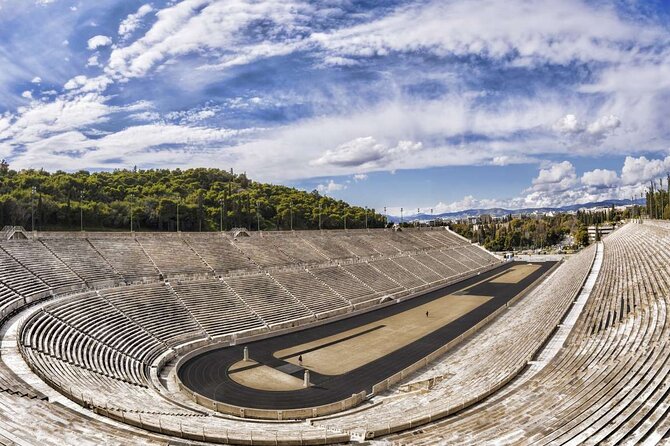
If the Acropolis gives you ancient height, Panathenaic Stadium gives you ancient sport. It’s called Kallimarmaro, and it’s famous for being built entirely of white marble. Originally constructed in the 4th century BCE, then reconstructed in the 2nd century CE, the stadium is shaped like a horseshoe and has seating for around 50,000.
It hosted the Panathenaic Games, and it later became the stage for the modern Olympics revival in 1896. That alone makes it feel meaningful even if you’re not a sports-history person. It’s also a nice breather stop—about 15 minutes—though the admission ticket isn’t included.
Admission for several other landmarks in this area is free, and this is where the tour becomes a quick “architecture and city rhythm” tour:
- The Academy of Athens (inspired by Plato’s ancient academy) with statues of Athena and Apollo.
- The National and Kapodistrian University of Athens, Greece’s oldest and largest university, part of the Athenian Trilogy look.
- The National Library of Greece, founded in 1832 in a grand neoclassical building by Theophil Hansen.
Each of these stops gets around 10 minutes, which is perfect if your goal is to see them and keep moving rather than spending hours inside.
If you like cities where the education system and national culture show up in the buildings, this cluster is a satisfying add-on. It also gives you variety after the heavy ancient sightseeing.
Temple of Olympian Zeus and the scale lesson

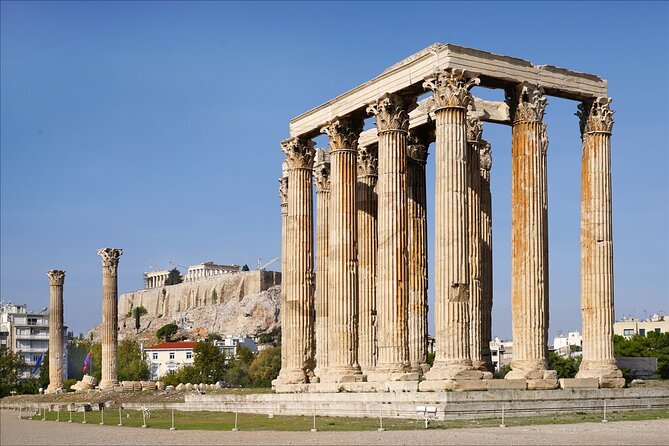
Next up is the Temple of Olympian Zeus, a site where scale does the talking. Construction started under tyrants in the 6th century BCE and stretched until the 2nd century CE. You don’t get the full temple standing as it once was, but you still get a strong sense of ambition.
The temple was dedicated to Zeus and once held a massive chryselephantine statue of the god. Today, you’ll mainly see ruins and a handful of columns, including Corinthian columns reaching about 17 meters tall.
Since this stop is free, it’s an efficient way to keep the “ancient engineering” theme going without adding ticket costs. It’s also a good moment to pause, look up, and realize why Athens always felt like a place trying to outdo itself.
Optional upgrades: Acropolis Museum vs. Ancient Agora (and how to choose)
This tour has two optional add-ons that can turn it from “highlights” into “deeper context.” Each optional choice adds about 60 minutes, and entrance fees are not included.
The Acropolis Museum option
The Acropolis Museum is designed specifically to house artifacts from the Acropolis. It opened in 2009 and sits at the foot of the hill, with views toward the Parthenon. If you go, you’re likely to care about:
- the Parthenon Gallery with glass walls that align your viewpoint toward the temple outside,
- key sculptures like the Caryatids from the Erechtheion (the original statues),
- and the overall museum design that connects past and present, including floor sections that reveal ancient ruins.
This is the better pick if you want the story of the Acropolis explained through objects and reconstructions.
The Ancient Agora option
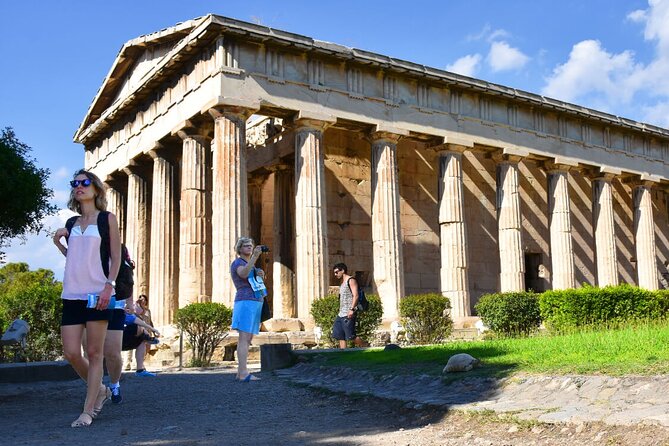
The Ancient Agora is Athens’s older “everyday power center.” It served as the hub for social, political, and commercial life from as early as the 6th century BC onward. If you choose this option, you’ll likely notice:
- the layout of public and civic spaces,
- the Stoa of Attalos (a long covered colonnade used for gatherings and shopping),
- the Bouleuterion (the city council building),
- and nearby religious anchors like temples and the Altar of the Twelve Gods.
This is the better pick if you’re curious about how people lived and argued in Athens—not just how temples looked.
How I’d choose
If you’re only going to add one extra hour, I’d choose based on your curiosity:
- Want the Acropolis to make more sense? Pick the Museum.
- Want to understand Athens as a living city? Pick the Agora.
And if you pick neither, you can still have a great day. The main tour already gives you the landmarks people come for.
Price and logistics: what you’re paying for, and what you still have to handle
At $145.12 per person for roughly 5 hours, you’re buying three things:
- Private transportation with hotel pickup/drop-off and an air-conditioned van,
- a fluent English-speaking driver with deep historical context,
- and an organized route that saves you time and stress moving between areas.
What you are not buying is ticketed site time:
- Acropolis Hill admission (€30 per person) is extra.
- Panathenaic Stadium admission is extra (ticket not included).
- Acropolis Museum admission (€20 per person) is extra if you choose that option.
- Ancient Agora admission (€20 per person) is extra if you choose that option.
Other major stops are listed as free, including Hadrian’s Arch, Hellenic Parliament, Temple of Olympian Zeus, Academy/University/Library area stops, and the Tomb of the Unknown Soldier.
One more realistic note: the driver is not licensed to accompany you inside sights. So you’ll hear context and get guidance, but once you cross into the major sites, you’re navigating the space on your own (with your own ticket and your own time).
For me, that’s not a deal-breaker—it’s common in city sightseeing—but you should plan for it so you don’t end up expecting a full inside-led guided tour.
Comfort, timing, and small habits that make the day smoother
Athens can go from breezy to sweaty fast, especially with uphill walking and bright stone. This tour helps because you have:
- bottled water,
- WiFi on board,
- and the ability to step into air-conditioned comfort between stops.
A few habits I’d use with this schedule:
- Wear comfortable shoes because you’ll move between streets and historic areas.
- Pre-order your tickets a few days early when you can. It’s listed as available at hhticket.gr.
- If you want maximum efficiency at the Acropolis, arrive ready to follow the plan, then adjust with short rests rather than long detours.
- Use the WhatsApp channel so you can stay flexible without calling repeatedly.
Also, if you’re traveling with kids, note that a child seat/booster is available, and service animals are allowed.
Should you book this Athens half-day tour?
Book it if you’re the type who wants a smart first pass at Athens: Acropolis and Parthenon, plus the central landmarks around Syntagma Square, and enough city variety to keep the day from feeling repetitive. The private vehicle makes it practical, especially if you hate wrestling with public transit or you’re short on time.
Skip it or adjust your plan if your top priority is a fully guided inside experience at the major sites. This tour’s model is driver-led context outside and self-paced exploration inside, so you’ll need to be comfortable handling the museum and ticketed areas on your own.
If you want to turn a good half-day into a memorable one, strongly consider adding the Acropolis Museum (for artifacts and context) or the Ancient Agora (for how civic Athens worked). That extra hour is often what turns photos into real understanding.
FAQ
Is the tour guided inside the major sites?
You’ll have a fluent English-speaking driver with deep knowledge of Athens history, but the driver is not licensed to accompany you inside sights. You’ll explore each stop yourself once you arrive.
Are entrance tickets included?
No. Entrance fees are not included. The Acropolis Hill admission is listed as €30 per person, the Acropolis Museum is €20 per person, and the Ancient Agora is €20 per person.
How long is the tour?
It runs about 5 hours.
Does the tour include pickup and drop-off?
Yes. Hotel pickup/drop-off is included by any location, and airport pickup comes with an additional cost. The driver arrives about 5 minutes before your scheduled start time.
What language is the tour offered in?
The tour is offered in English.
Can I add the Acropolis Museum or the Ancient Agora?
Yes. The Acropolis Museum and Ancient Agora are optional add-ons that add about 60 minutes each, depending on the option you select. Entrance fees for both are not included.
Can I cancel for a refund?
Yes, free cancellation is available up to 24 hours in advance for a full refund.
You Might Also Enjoy




More Half-Day in Athens


More Tours in Athens


More Tour Reviews in Athens
- All Day Cruise -3 Islands to Agistri,Moni, Aegina with lunch and drinks included
★ 5.0 · 4,958 reviews