REVIEW · ATHENS
Panorama of Athens in 6 hours
Book on Viator →Operated by Andrew's Unique Tours · Bookable on Viator
Athens rewards momentum, and this half-day plan keeps it moving. In just 5 to 6 hours, you’ll cover the big hitters of ancient Athens on and around the Acropolis, then roll into the Agora, Plaka, and a few modern landmarks for contrast. I like that it’s private (up to 3 people) and runs on a hotel pickup-and-drop rhythm, so you don’t lose time figuring out buses or taxis.
Two things I especially like: the narration comes from a driver who knows the sights (you’re not just chauffeured), and the route is designed for quick hits with short walks at each stop—ideal when your time is tight. One consideration: entrance fees aren’t included, and the drive-through format means you’ll want to choose priorities, because you won’t linger long at every monument.
Key Takeaways:
- Private door-to-door pickup keeps your day efficient from the start.
- Driver-led history helps you connect sites fast, without waiting for a licensed guide at each stop.
- Acropolis focus first means you’ll hit Propylaea, Athena Nike, Parthenon, and Erechtheion in one compact window.
- You get big-picture variety: Olympian Zeus, the presidential Changing of the Guard, Panathenaic Stadium, and more.
- Short visits by design let you see a lot, but you’ll feel the pace.
- Entrance tickets are extra—plan ahead so the day stays smooth.
In This Review
- Private Athens in 5–6 Hours: What this “Panorama” plan really delivers
- Price and Value: $459.74 per group (up to 3) and what’s included
- Hotel Pickup to Smart Routing: comfort, timing, and how the driver changes the day
- Acropolis First: Propylaea, Athena Nike, Parthenon, and Erechtheion in one packed hour
- The Walk Down the Hill: Dionysus Theatre, Herodes Atticus, and Mars Hill views
- Beyond the Acropolis: Olympian Zeus, Lycabettus, and the Panathenaic Stadium
- Changing of the Guard: Evzones at the Presidential Mansion (and why it’s worth timing)
- Agora to Plaka: the heart of ancient public life and Athens’ old-street mood
- Monastiraki Flea Market: shopping time without wrecking your schedule
- Athens institutions from street level: Academy, University, and the National Library
- So who is this tour for? Best-fit travelers and small reality checks
- Should you book Panorama of Athens in 6 hours?
- FAQ
- How long is the Panorama of Athens tour?
- Is this a private tour?
- Where is the pickup and drop-off?
- What language is offered?
- What vehicle do you use?
- Are entrance tickets included?
- Is a licensed tour guide included?
- What’s included besides transport?
- Is the Changing of the Guard part of the itinerary?
- What if the weather is bad?
Private Athens in 5–6 Hours: What this “Panorama” plan really delivers
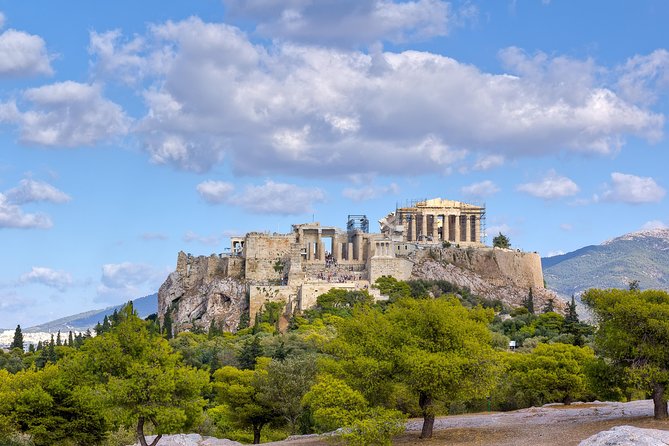
This is the kind of Athens tour I recommend when you have limited time but still want the highlights to feel connected. Instead of bouncing around on public transport, you start with pickup, ride in a private vehicle, then do a series of short, well-chosen stops. The result is a day that feels like a tour and a city orientation at the same time.
You’ll move through multiple layers of Athens: ancient sanctuaries on the hill, political and religious life in the Agora, traditional neighborhood streets in Plaka, and a few modern anchors like the presidential area. If you like understanding how the city formed—rather than just collecting photos—this route supports that.
The pacing also matters. Many stops are built around brief view-and-walk moments, with the Acropolis as the main focus. If you’re the type who enjoys long museum time, you may find yourself wanting more hours. If you’re the type who wants to see a lot and then come back for deeper exploration, this makes sense.
Price and Value: $459.74 per group (up to 3) and what’s included
The headline price is $459.74 per group for up to 3 people. That’s often the right way to think about it: if you’re splitting the cost with two others, you can turn a pricey private day into something more reasonable per person.
What you get for your money is practical, not flashy:
- Hotel pickup and drop-off
- Private air-conditioned transport (SUV Kodiaq or a luxurious C-Class taxi)
- Bottled water
- A driver with history knowledge who helps you understand what you’re seeing
The biggest “value lever” is time saved. Athens is busy, parking can be annoying, and the Acropolis area is not a place where you want to be solving logistics mid-trip. A private vehicle and driver planning the flow can keep the day from turning into stress.
What you should budget separately: entrance tickets. The Acropolis fee alone is listed as €30 per person (with free entry for up to 18 years). Other major sites are marked as admission not included, so you’ll want to factor those in. If you’re traveling with a group of three, it’s easier to absorb those add-ons without feeling like the tour price is out of sync.
You can also read our reviews of more tours and experiences in Athens.

Hotel Pickup to Smart Routing: comfort, timing, and how the driver changes the day
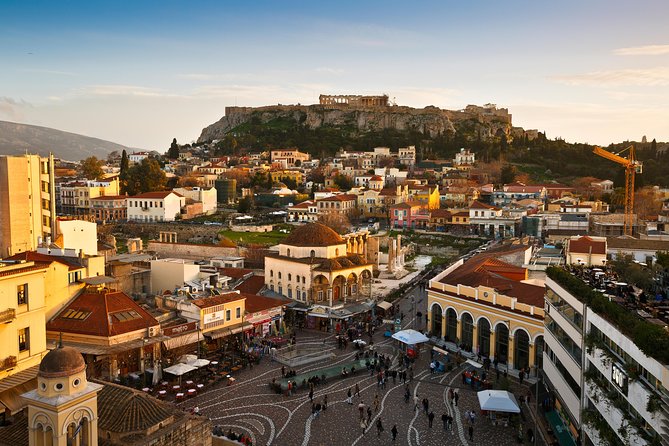
This is a private tour, so your day is shaped by your group instead of being forced into a fixed group pace. In practice, that often shows up as:
- More direct access to key stops
- Less time spent wandering between locations
- Better use of your limited hours
The driver role is a big deal here. The tour notes “professional drivers with knowledge of history,” and a key detail is that the driver is not licensed to accompany you in any site. Translation: you’ll get context and guidance for what you’re looking at, but don’t expect a licensed museum-style walkthrough inside every ticketed area. For many visitors, that’s fine; for others who want deep inside-the-collections commentary, you may feel the difference.
Still, the reviews you can expect from this setup tend to focus on something practical: guides who explain clearly, adjust when someone needs extra care, and help you avoid wasting time. For example, one review highlighted Andrew helping with a knee issue by getting the group into an elevator option at the Acropolis. Another praised Alex for bringing history to life with context and even showing historical photos, plus handling where to park and how to move through a crowded city.
If you want the day to feel smooth, those small coordination skills matter as much as the sightseeing list.
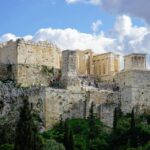
Acropolis First: Propylaea, Athena Nike, Parthenon, and Erechtheion in one packed hour
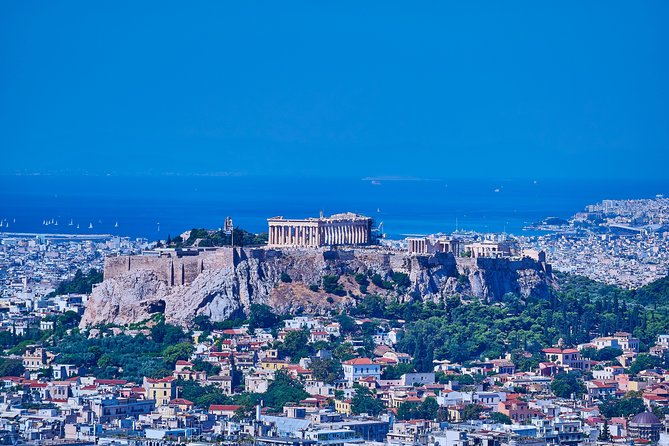
Your route starts with the Acropolis, and you’ll spend about one hour there. That’s the correct choice. Even if you only have a short visit, the hill rewards an intentional entry rather than a random drop-off.
You’ll pass the monumental gate of Propylaea, then see key structures closely tied to Athena:
- Temple of Athena Nike (noted as the earliest fully Ionic temple on the Acropolis, built around 420 BC)
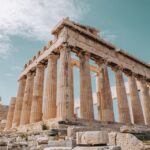
- Parthenon (built between 447 and 438 BC, dedicated to Athena Parthenos)
- Erechtheion (a complex replacement built in the last twenty years of the 5th century BC)
What I like about this approach is that it teaches the Acropolis as more than one building. Propylaea frames the experience like a ceremonial doorway. Athena Nike signals refined Ionic design. The Parthenon represents political power at the height of Athenian democracy. The Erechtheion adds a more layered, architectural story—separate chambers tied to different religious associations.
There’s also a practical benefit: you’ll get a panoramic view of Athens and the port of Piraeus from the slopes area. That view works as a reality check. You’re standing on a hill while the modern city spreads around you, and it helps you picture how this sacred ground sat inside a working metropolis.
The catch: entrance tickets are not included, and the Acropolis fee (Acropolis & slopes) is listed at €30 per person. With limited time, that means your best move is to buy tickets ahead so you’re not spending your “Acropolis hour” in a line.
The Walk Down the Hill: Dionysus Theatre, Herodes Atticus, and Mars Hill views
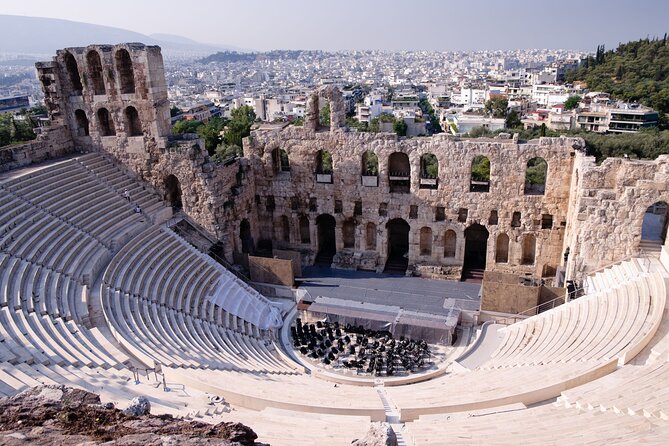
After the main Acropolis sweep, you’re not done—you’re guided toward the related ancient sites at the base and slopes. You’ll see:
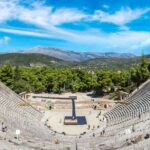
- The ancient Theatre of Dionysus (noted as the oldest open-air theatre in the world)
- The Odeon of Herodes Atticus (a Roman stone theatre structure on the southwest slope)
- Areopagus (Mars Hill)
Even if your stops here are brief (the schedule lists short time windows), these landmarks help you understand how Greek drama and civic life shared the same landscape. Dionysus ties to the major playwrights named in the tour description—Aeschylus, Sophocles, Euripides, and Aristophanes—so you’re not just seeing seats carved into rock. You’re seeing where plays were staged and ideas were tested in public.
The Herodeon adds Roman layering to the story. It’s a reminder that Athens never froze in time. Emperors and later generations kept reusing and reshaping the monumental spaces.
What to watch for: because these are quick photo-and-look moments, you’ll want to mentally decide what you’re prioritizing. If the Parthenon is your main goal, don’t let the slope stops steal your attention. If theatre is your passion, spend a little longer orienting yourself to what the seating implies.
Beyond the Acropolis: Olympian Zeus, Lycabettus, and the Panathenaic Stadium

Half-day touring in Athens can feel like a blur unless you have a few “anchor points.” This route provides several anchors outside the Acropolis zone.
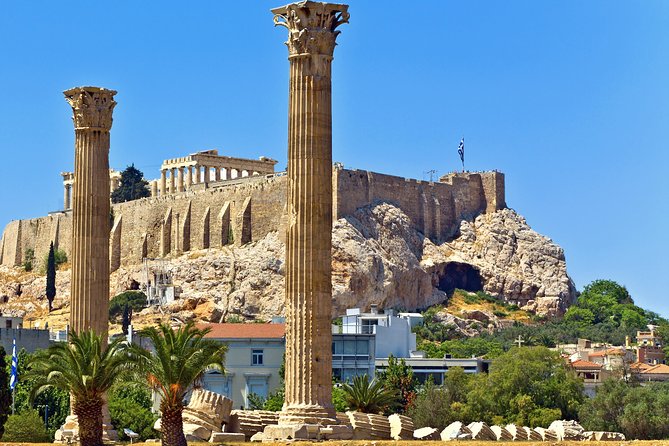
You’ll visit the Temple of Olympian Zeus, a colossal project that began in the 6th century BC and wasn’t completed until the reign of Roman emperor Hadrian in the 2nd century AD. Seeing these columns (and the scale implied by what’s left) gives you a different angle on power—more imperial and later—compared to the democratic image of the Parthenon.
Then there’s Mount Lycabettus, listed as 277 meters high, where thousands of Athenians and tourists climb for views. The stop is short, but the key value is the viewpoint logic. From here, you can connect the dots between neighborhoods and major landmarks without needing a museum plan.
Another highlight: Panathenaic Stadium. This stop is worth it if you like the Olympics story being literally built into the city. The tour notes that the stadium’s modern renovation for the first modern Olympics in 1896 involved marble works financed by Georgios Averof, and that its shape matches the ancient 4th-century BC stadium.
A practical note: you’ll be moving from one “sense of time” to another—ancient temples, then a mountain lookout, then a sports venue designed to replay the past in marble. It’s a fun contrast loop, and it helps your brain organize what you’re seeing.


Changing of the Guard: Evzones at the Presidential Mansion (and why it’s worth timing)
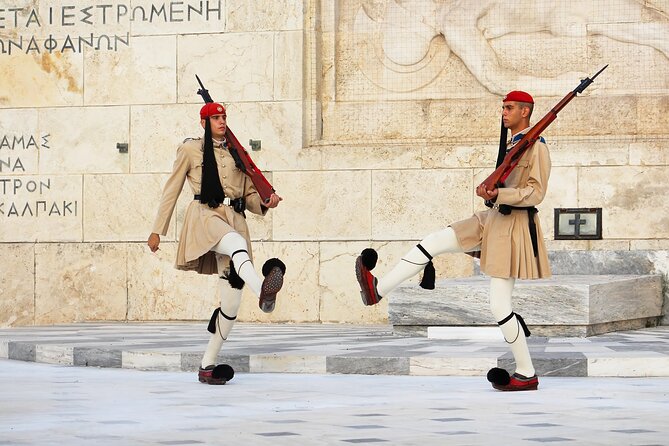
One scheduled cultural moment is the Changing of the Guards at the presidential mansion. The tour description emphasizes the Evzones and says it occurs every day, every hour.
This is one of those Athens experiences that feels instantly recognizable, even if you’re not planning around it. The value is that it’s a living tradition performed in a central, easy-to-reach place. It also gives your day a break from the ancient-only focus.
Because it happens hourly, you’ll want to be there when your driver’s schedule places you. With a half-day route, the timing matters. If you miss it, you’ll still have plenty of monuments to see—but it’s the kind of moment that can turn a good day into a memorable one.
Agora to Plaka: the heart of ancient public life and Athens’ old-street mood
After the Acropolis and Zeus area, the route steps into the lived-in layers of Athens.
You’ll visit the Ancient Agora of Athens, described as the heart of political, commercial, administrative, social, and religious activity, including the seat of justice. Even in short time windows, the Agora works because it was a real center of daily civic life—not only ceremonial space.
You’ll also see:
- Stoa of Attalos, highlighted as the main monument and museum at the Ancient Agora after the Temple of Hephaestus
- Temple of Hephaestus, noted as among the best-preserved ancient temples in Greece
- Plaka, the old historic neighborhood under the Acropolis, with neoclassical buildings, cafés, souvenir shops, and narrow streets between Syntagma and Monastiraki
I like how Plaka shifts the day from strict monuments to human-scale streets. It’s the part of Athens where you can slow down for a bit—grab a drink, browse, and just watch how people move.
The Temple of Hephaestus also helps anchor your understanding of what “Athens architecture” looks like at street level. It’s not the Acropolis peak; it’s a temple that still feels part of the city’s everyday geography.
Monastiraki Flea Market: shopping time without wrecking your schedule
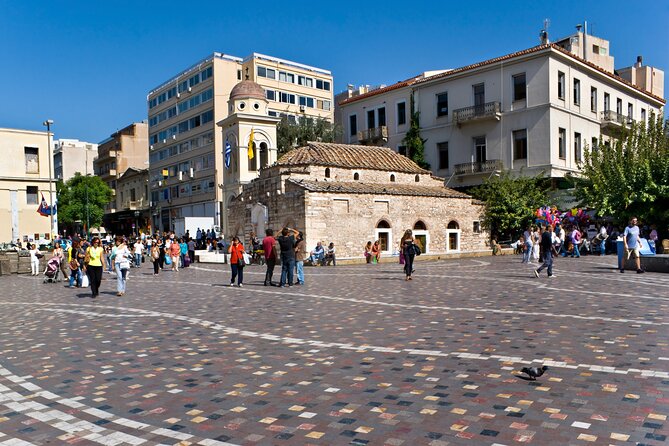
No Athens half-day feels complete without at least a taste of Monastiraki. This tour includes Monastiraki Flea Market (listed at about 30 minutes), right in the Monastiraki Square area.
This is perfect for people who want one practical shopping window—something to browse for small souvenirs, gifts, or just fun street energy. The stop is short by design, so it doesn’t hijack your day.
If you do want to buy things, I’d treat this as a quick scan-and-snag opportunity. With limited time, you can’t compare endlessly. Check prices quickly, ask about payment options if needed, and don’t get sucked into negotiating for something that you don’t love.
Athens institutions from street level: Academy, University, and the National Library
Between major monuments, the route also passes key intellectual and institutional landmarks.
The Academy of Athens is mentioned as being founded in 1926 and described as a copy of the Propylaea of the Acropolis. That detail matters. It turns Athens architecture into a conversation across centuries: the ancient forms echo into modern education.
You’ll also see the University of Athens, founded in 1837 by King Otto of Greece (named after him as Othonian University). And the National Library of Greece is noted as founded in 1832 by Ioannis Kapodistrias, with a mission to preserve evidence of Greek culture and human intellectual production.
These stops aren’t about climbing monuments. They’re about giving you a sense of how Athens treats knowledge as a public space. Even if you don’t go inside, the exterior context helps your mental map click.
So who is this tour for? Best-fit travelers and small reality checks
This is a strong choice if you fit one (or more) of these:
- You have only half a day and want a broad sweep of Athens highlights
- You’d rather ride in comfort and have the route planned than self-navigate
- You enjoy clear explanations and contextual stories (driver-led narration)
- You’re traveling with a small group and can split the cost
It’s also a good fit for families and couples who want flexibility. The reviews repeatedly emphasize patient, flexible hosting and real help when circumstances change. That’s not guaranteed in every tour, but the pattern here suggests it’s part of the service style.
The reality checks:
- You won’t spend long inside every ticketed site. This is a “see it all briefly” approach.
- Entrance tickets aren’t included for major stops, including the Acropolis & slopes.
- The schedule assumes moderate physical fitness, with walking on uneven historic ground and short climbs/views.
Should you book Panorama of Athens in 6 hours?
If you’re trying to make limited time count, I’d book this—especially if you’re splitting the $459.74 per group with up to two people. You get a well-structured route that hits the Acropolis core, then broadens into Agora, Plaka, Monastiraki, and a few major viewpoint or civic moments like Lycabettus and the Changing of the Guard.
I’d only skip it if your top priority is slow museum-level study or if you specifically want a licensed guide walking you inside each major archaeological space. In that case, you might prefer a more specialized guide format with fewer stops and more time per site.
My practical advice: plan your entrance tickets in advance (the Acropolis & slopes fee is clearly specified). Then show up ready for a brisk, well-timed day where the highlights connect into a single Athens story.
FAQ
How long is the Panorama of Athens tour?
It runs about 5 to 6 hours.
Is this a private tour?
Yes. Only your group participates (up to 3 people).
Where is the pickup and drop-off?
Hotel pickup and drop-off are included.
What language is offered?
The tour is offered in English.
What vehicle do you use?
A private air-conditioned vehicle is used, listed as SUV Kodiaq or a luxurious C-Class taxi.
Are entrance tickets included?
No. Entrance tickets are not included. Acropolis & slopes are listed as €30 per person (with up to 18 years free).
Is a licensed tour guide included?
No. A licensed tour guide is not included.
What’s included besides transport?
Bottled water is included.
Is the Changing of the Guard part of the itinerary?
Yes, the Changing of the Guard at the presidential mansion happens every day every one hour, and it’s included as a stop.
What if the weather is bad?
The experience requires good weather. If it’s canceled due to poor weather, you’ll be offered a different date or a full refund.
You Might Also Enjoy



More Tour Reviews in Athens
- All Day Cruise -3 Islands to Agistri,Moni, Aegina with lunch and drinks included
★ 5.0 · 4,958 reviews