REVIEW · ATHENS
Athens: Acropolis Guided Private Tour without Entry Ticket
Book on GetYourGuide →Operated by Secrets of Greece IKE · Bookable on GetYourGuide
The Acropolis is even better with a plan. This private, Spanish guided walk helps you connect the myths to the stones at the top of Athens, and you get time to ask questions along the way. I love the small private group format, and I also like how the licensed guide ties big sights like the Parthenon and Dionysus theater to what ancient Athenians actually did here.
The possible catch is simple: this is walking uphill on uneven ground, and the Acropolis entry ticket is not included—so you’ll want to buy it ahead and show up with the right timing.
In This Review
- Key highlights worth your attention
- Why this private Acropolis walk is worth it
- Starting at the Acropolis Metro: how to make the morning easy
- Ticket timing you must get right (and why it matters)
- Propylaea gateway to the citadel: your first big moment
- Parthenon area and Temple of Athena Nike: small but meaningful
- Erechtheion and the Caryatides details you should actually notice
- Odeon of Herodes Atticus and the theater story in stone
- Asclepius and Athena’s world: healing and power
- The 2-hour format: what you gain and what you won’t
- Price and value: $292 per group up to 3
- Who this tour suits best
- A quick note on guides and the tour vibe
- Should you book this Acropolis guided private tour?
- FAQ
- Is the Acropolis entry ticket included?
- Where do I meet the guide?
- How long is the tour?
- What language is the guide?
- How many people are in the private group, and what does the price cover?
- Does the tour involve uphill walking?
- What ticket time slot do I select?
- What if I cannot get the ticket online?
- Are strollers or wheelchairs allowed?
- What is the cancellation policy?
Key highlights worth your attention

- Myth-first explanations that match what you’re seeing at each stop, not just dates on a timeline
- Propylaea and the gateway moment where the site opens up before you climb deeper
- Major theaters in one loop, including Dionysus (17,000-seat scale) and the Odeon of Herodes Atticus
- Athena spots that are easy to miss, like the Temple of Athena Nike and Caryatides details
- Small-group Q and A time, helpful when you want context without feeling rushed
Why this private Acropolis walk is worth it
The Acropolis can be spectacular and confusing at the same time. Without guidance, you can end up taking photos while the stories float away. With a licensed guide, you get the version of Athens that ancient people experienced here: religion, festivals, power, and myths tied to specific buildings.
What I like most is the way the tour builds momentum. You start at the main entry gateway experience and move through the key landmarks—Propylaea, temples linked to Athena, the theater spaces, and the carved Caryatides—so everything feels connected. Instead of treating each ruin like a separate stop, you see how the whole complex worked as a stage for ceremonies and civic identity.
You’ll also benefit from the format. This is priced as a private group up to 3, so you’re not stuck in a big crowd with a single-file view. That matters at the Acropolis, where the ground is uneven and spacing gets tight. And if you care about the stories—especially Greek mythology referenced by the ruins—having a guide who can answer your questions makes the visit feel alive.
You can also read our reviews of more tours and experiences in Athens


Starting at the Acropolis Metro: how to make the morning easy
You meet your guide at the entrance of the Metro station Acropolis, on the street level. That’s actually a smart choice, because it cuts out the “wait for a bus and hope everyone arrives” chaos. You’ll just get yourself there, keep it simple, and start walking.
The tour ends back at the meeting point, so you’re not left figuring out transit from somewhere obscure on the hill. It’s also useful if you want to roll directly into lunch or keep exploring on your own afterward.
No hotel pickup or drop-off is included. If you’re staying outside central Athens, plan for a straightforward trip to the Acropolis Metro. Once you’re there, you’re walking into the site with a guide and staying focused on the important parts instead of logistics.
Ticket timing you must get right (and why it matters)

This tour does not include Acropolis entry tickets, and tickets must be purchased before the start. That’s the big planning step, because entry timing can affect whether you’re stuck waiting at the ticket office.
Here’s what you need to know:
- Purchase your ticket online before the tour.
- Ticket selection depends on season:
- Low season (01/11–31/03): select 09:00–10:00
- High season (01/04–31/10): select 08:00–09:00
- If you cannot get tickets online due to availability, the provider says they will help.
If you arrive without your ticket, you must go to the ticket office area of the South entrance 30 minutes before your tour time. There’s a practical payoff: once you pick up the tickets, the meeting point is less than 2 minutes’ walk away.
Why I’m stressing this: the Acropolis is one of those places where a small timing slip can turn your visit into a scramble. Get the ticket sorted, show up on time, and the 2-hour guided portion stays smooth.
Propylaea gateway to the citadel: your first big moment
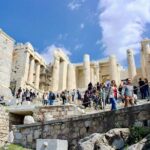
The tour walks you through the Acropolis as you would enter it in ancient times, starting with the gateway experience at Propylaea. Even if you’ve seen photos, it hits differently in person because your vantage shifts as you approach—suddenly the complex isn’t just ruins, it’s a defended, designed space.
This is where the guided approach really helps. Your guide points out what you’re looking at and why it matters: Propylaea isn’t just a doorway, it’s a statement about status and power. It sets the tone for what comes next—temples, ceremonies, and the stage-like view toward the city.
You’ll also “gaze at Caryatides” during the walk. Caryatides are those sculpted female figures used as architectural supports, and once you know what they represent and how they’re placed, they stop being background decoration and start feeling purposeful.
Expect a steady climb and uneven footing as you move between viewpoints. Plan comfortable shoes and don’t treat the walk like a gentle stroll.
Parthenon area and Temple of Athena Nike: small but meaningful
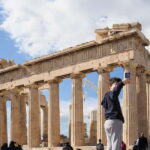
The tour includes stops around the sacred heart of the Acropolis—Parthenon area and the walk through the space dedicated to Athena, the goddess protector of the city. The Parthenon is the headline, but you’ll get more out of it when you also understand what Athena meant to the Athenians who built and used these spaces for major religious festivals.
You’ll also see the Temple of Athena Nike. It’s described as the smallest temple on the Acropolis, and that detail matters. When a site’s big structures steal the spotlight, a smaller temple can get overlooked. A guide helps you shift your attention: you’ll understand why the “small” building still carried weight in the city’s belief system.
This is also where the mythology commentary becomes practical. You’re not just hearing myth as bedtime stories. You’re hearing how myth connected to what people did here—how festivals and civic identity were shaped by the stories tied to these places.
If you love the moment when architecture and story click together, this part of the tour is one of the strongest.
You can also read our reviews of more guided tours in Athens


Erechtheion and the Caryatides details you should actually notice
The Erechtheion gets attention for a reason, and the tour leans into it. Named after the demi-god Erechtheus, it’s another reminder that the Acropolis was tied to names, legends, and religious meaning—not only building design.
The Caryatid stone carvings are part of what makes Erechtheion so memorable. But the key is knowing what you’re looking at while you’re standing there. Without guidance, many visitors glance at them and move on. With a guide, you’re more likely to notice the details and understand the symbolic role these figures play in ancient architecture.
This is also a good time to ask questions. Because this is a private group, you can slow down if a concept sparks your curiosity—like why certain myth names show up in temple spaces or how religious stories shaped the physical layout.
A small consideration: because you’ll be walking uphill on uneven surfaces, plan for brief slowdowns. It’s not hard terrain, but it’s not flat, and you’ll likely pause at viewpoints where crowds can gather.
Odeon of Herodes Atticus and the theater story in stone
The tour includes two theater-related stops that give you a sense of how performance and public life blended with religion.
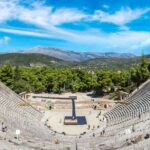
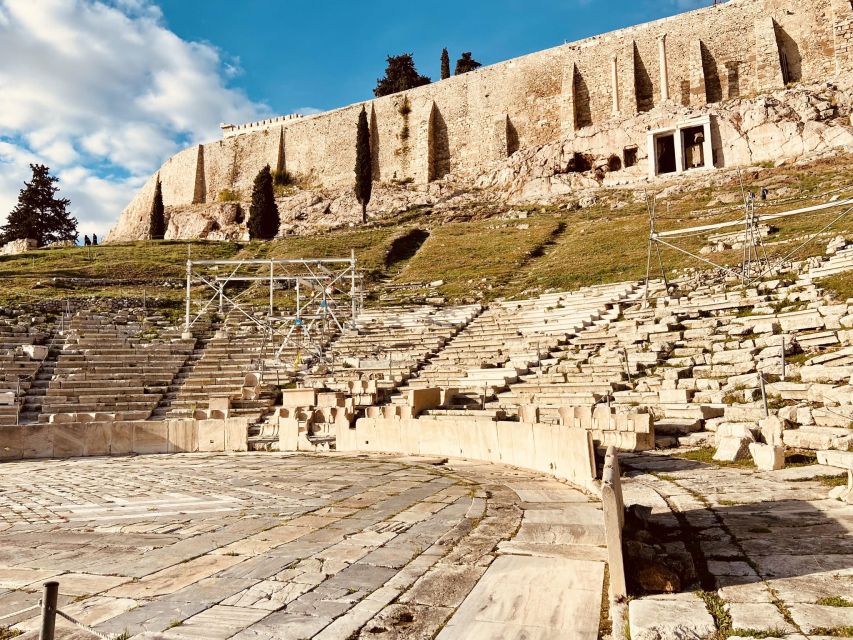
First, you’ll visit the theater of Dionysus, which held 17,000 spectators and was used to host festivals honoring the birth of the Greek god. That specific detail helps you imagine the scale and the purpose. It’s not just “an old theater,” it’s part of a system where festivals brought the community together.
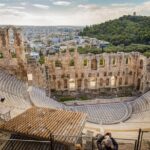
Then comes the Odeon of Herodes Atticus, described here as a giant stone theater. This adds contrast: Athens wasn’t just one venue for one kind of event. The Acropolis complex and the city’s larger cultural life used stone settings to turn myth and public participation into something you could actually experience.
What I like about this portion is the way the guide connects the myths to the physical spaces. Even if you don’t remember every name, you start to see the logic: performance wasn’t separate from religion. It was tied to the stories people lived by.
Asclepius and Athena’s world: healing and power
Along the route, you also visit the temple of Asclepius and the Odeon of Herodes Atticus highlights, with the guide’s commentary linking mythology behind the ruins. Asclepius is the healing figure in Greek tradition, and when you place that alongside Athena’s protective role, the Acropolis starts to look like more than a monument—it becomes a map of different human needs.
This part of the tour is valuable if you like your history with a human angle. Healing, protection, civic identity, and festivals all show up as themes, and the ruins become evidence for how people explained the world.
The practical benefit is that you finish with a fuller mental picture. When you walk around the site on your own afterward, you’ll notice you can connect the dots more quickly because you’ve been given the story thread.
The 2-hour format: what you gain and what you won’t
This is a 2-hour guided private tour. That’s a good length for the Acropolis because it’s enough time to cover the major highlights and still give you a confident sense of what each area means.
But it’s also not designed to feel like an all-day archaeology seminar. You’ll see key buildings and theaters and learn the stories behind them. You won’t get endless slow walking through every corner of the complex. If you want that, use the free time after the tour to linger, because you’ll have the context to explore on your own.
The tour ends back at the meeting point, and you’ll have free time to stay longer and explore at your own pace. This is where you can turn “seeing” into “really noticing.” Go back to the areas that clicked for you during the guided portion. Spend extra time with viewpoints, and don’t be afraid to just pause and let the scale sink in.
Price and value: $292 per group up to 3
The price is $292 per group up to 3 for a 2-hour private tour. That can sound high until you do the simple math.
If you travel with 3 people, you’re effectively splitting the guide cost—so the per-person price drops significantly compared to solo-guided options. Even with 2 people, it can still feel like good value if you compare what you get: a licensed guide, a focused route through top sites, and a chance to ask questions without competing with a big crowd.
The one add-on you should budget for is the Acropolis entry ticket, which is not included. Once you factor that in, the value still can be solid if you care about understanding what you’re seeing instead of just collecting photos. If you’re the type who enjoys reading signs and wandering independently, you might choose to self-guide. But if you want the mythology explained and the stops prioritized, this private format is built for exactly that.
Who this tour suits best
This works especially well if you want:
- A guided route through the biggest Acropolis highlights without getting lost in the story
- Spanish commentary and the ability to ask questions during the walk
- A private group setup for a more personal pace
It may not fit as well if you need easy, flat walking, because the tour requires walking uphill and on uneven surfaces. The tour also notes restrictions: baby strollers are not allowed, and non-folding or electric wheelchairs are not allowed.
If you’re comfortable with some climbing, and you want myth tied directly to the ruins, this is a strong match.
A quick note on guides and the tour vibe
The tour is led by a live Spanish licensed guide. Names mentioned in the experiences include Sara and Amancio, both of whom were praised as excellent guides. That lines up with what you hope for here: clear explanations, steady pacing, and the ability to translate myth into something you can see on the stone.
Since this is private, your guide can also respond to your interests. If you’re more curious about theaters, temples, or the mythology thread, that flexibility tends to make a short 2-hour tour feel more satisfying.
Should you book this Acropolis guided private tour?
I’d book it if you want the Acropolis story told in a way that helps you actually understand what you’re looking at. The combination of a licensed guide, a private group format, and a focused route through Propylaea, Parthenon area, Erechtheion, Dionysus’ theater, the Odeon of Herodes Atticus, Caryatides, and Athena Nike is the sweet spot for most visitors.
I’d skip it if you’re only interested in a quick visual walkthrough and you’re fully comfortable self-navigating and reading explanations on your own. Also, if uphill uneven ground is an issue for you, you’ll need to think carefully before committing.
If you do book, treat the ticket timing as your top job. Get the right time slot for your season, show up ready to enter, and you’ll get a much smoother, more rewarding Acropolis visit.
FAQ
Is the Acropolis entry ticket included?
No. The guided tour includes the licensed guide, but Acropolis entry tickets must be purchased separately.
Where do I meet the guide?
Meet your guide at the entrance of the Metro station Acropolis, on the street level.
How long is the tour?
The tour lasts 2 hours. Starting times vary, so check availability for the exact slot.
What language is the guide?
The live tour guide speaks Spanish.
How many people are in the private group, and what does the price cover?
It’s a private group priced at $292 per group up to 3 people, covering the guided tour with a licensed guide.
Does the tour involve uphill walking?
Yes. The tour requires walking uphill and on uneven surfaces.
What ticket time slot do I select?
For low season (01/11–31/03), select 09:00–10:00. For high season (01/04–31/10), select 08:00–09:00.
What if I cannot get the ticket online?
If you can’t get the ticket because there is no availability, the provider will help.
Are strollers or wheelchairs allowed?
Baby strollers are not allowed. Non-folding wheelchairs and electric wheelchairs are also not allowed.
What is the cancellation policy?
You can cancel up to 24 hours in advance for a full refund.
You Might Also Enjoy




More Tickets in Athens

More Tours in Athens



More Tour Reviews in Athens
- All Day Cruise -3 Islands to Agistri,Moni, Aegina with lunch and drinks included
★ 5.0 · 4,958 reviews