
REVIEW · ATHENS
Acropolis Museum E-Ticket and Multilingual Audio Guide
Book on Viator →Operated by Clio Muse Tours · Bookable on Viator
Skip lines; hear Parthenon stories on your phone. This Acropolis Museum experience pairs a prebooked e-ticket with an offline, self-guided audio tour from the Clio Muse App, so you can focus on artifacts instead of standing around. And because the audio works offline with an interactive map, it’s built for real-world museum wandering, not perfect internet.
What I love is the no-fuss entry flow: your e-ticket gets emailed, you go straight to the expedited line, and you just get scanned—no confusing pickup stop. I also really like the offline setup with the audio tour and map, which helps you avoid roaming headaches while you move between galleries.
My only real caution: this is tech-dependent. The audio tour requires a compatible Android or iOS phone and needs you to download the tickets/app/audio ahead of time, and there’s no live guide on site if your setup fails.
In This Review
- Key highlights worth your attention
- Skip-the-line e-ticket: the fast way into the museum
- Getting the Clio Muse audio ready: what you must do before you go
- Inside the museum: how the galleries flow so you don’t feel lost
- Archaic Gallery: monsters, heroes, gods, and the shift to democracy
- Parthenon Gallery: Panathenaic frieze and myth scenes that land fast
- Third-floor videos and the underground site you’ll be glad you saw
- Audio guide pacing: when it works brilliantly and when it won’t
- Crowds, timing, and security: how to keep your visit calm
- Price and value: what $40.32 includes and why it can be fair
- Who should book this self-guided Acropolis Museum ticket
- Should you book the Acropolis Museum e-ticket and audio guide?
- FAQ
- Is the admission ticket included?
- How long does the experience take?
- Do I need an internet connection during the visit?
- Do I need a live guide?
- Where do I meet, and where does it end?
- What do I need to bring?
- Which phones are compatible with the audio tour?
- When should I download the app and audio?
- Is this purchase refundable or changeable?
- Can I qualify for reduced or free admission?
Key highlights worth your attention

- Prebooked e-ticket emailed to you so you can go straight to the expedited museum line
- Offline audio tour + offline interactive map to avoid roaming charges
- Story-driven route through the Archaic and Parthenon Galleries at your own pace
- Panathenaic Procession frieze and myth scenes like Athena’s birth and the Centaurs battle
- Third-floor videos help first-timers understand what they’re seeing
- No live guide included, so it’s best for people who enjoy self-guided learning
Skip-the-line e-ticket: the fast way into the museum
The biggest value here is simple: you buy the admission experience plus the e-ticket service, then use it at the museum for expedited entry. The meeting point is the Acropolis Museum itself, at Dionysiou Areopagitou 15, Athina 117 42. You’ll also be glad it’s near public transportation, because Athens is easier when you’re not juggling transfers with a timed ticket.
When you arrive, plan on a security check, and keep bags and luggage minimal. This is one of those small things that can quietly add 20 minutes if you arrive with a large bag or get slowed down at the checkpoint.
Once you’re through security, look for the line meant for your kind of ticket. The rule of thumb is: have your ticket ready either downloaded to your phone or printed, then get it scanned right at the entrance.
Practical tip: if you’re going with kids, this kind of entry system is often smoother because you’re not hunting for a separate pickup desk. Just get everybody to the scanner and let the museum do what museums do.
You can also read our reviews of more tours and experiences in Athens



Getting the Clio Muse audio ready: what you must do before you go

This experience uses the Clio Muse App plus an audio tour that you access with a secure promo code. It also includes offline content—an audio guide and an offline interactive map—so you can move freely without relying on cell signal.
Here’s what you need to take seriously:
- You must have an Android or iOS smartphone (the tour is not compatible with Windows Phones, older iPhone models like iPhone 5/5C and older, and some older iPod/iPad devices).
- You’ll want 100–150 MB of free storage space.
- Download the tickets, download the app, and download the audio tour ahead of time.
The instruction that matters most: after booking, you get an email with how to access and download everything. If that email lands in spam, you’ll only notice when it’s too late—so check spam before you leave.
Also, bring your own headphones. The experience doesn’t include them. If you’re the type who likes audio at full clarity, a small pair of wired or Bluetooth headphones makes a big difference.
My advice: charge your phone fully. Museums are famous for dim Wi-Fi, dead batteries, and people trying to free up storage at the exact worst moment.
Inside the museum: how the galleries flow so you don’t feel lost

The Acropolis Museum is designed to help you understand the Acropolis artifacts in context, but it can still feel like a lot when you’re staring at stones and marbles that all look “ancient” to the untrained eye.
The audio route helps because it guides you through the story in a logical sequence: early works and artistic evolution first, then the Parthenon’s major decorative programs. The offline interactive map also helps you recover when you take a wrong turn—something that’s surprisingly common in big museums.
For first-timers, I’d treat the museum like a guided walk, even though you’re not following a human guide. Listen to the audio in order if you can, then go back and linger where something grabs you.
Archaic Gallery: monsters, heroes, gods, and the shift to democracy

Your visit starts by moving into the story behind the museum’s collection, beginning with the Archaic Gallery. This is where the experience tries to do something important: explain how Greek art develops alongside Greek society.
You’ll get a guided look at the city’s transition to democracy, not as a history lecture, but as part of how people represented ideas—through monsters, heroes, gods, and those famous iconic approaches to the human body. The audio framing makes it easier to notice patterns, rather than just reacting to individual statues.
A drawback of any museum audio is that it can make you feel like you should keep moving. But the nice thing here is that it’s self-guided: if the Archaic style clicks for you, slow down. If it doesn’t, you can move on without feeling like you’re disappointing a guide.
How to get the most out of this gallery: focus on one theme at a time. For example, listen for what the audio says about how bodies and figures were shown, then look for that same idea repeated in multiple objects.
Parthenon Gallery: Panathenaic frieze and myth scenes that land fast

Next comes the Parthenon Gallery, which is where the museum usually makes people stop scrolling in their brains. The focus here is the Parthenon as a whole narrative system—architecture plus storytelling.
This is where you’ll hear about the Panathenaic Procession, pieced together from the frieze. That matters because many visitors just see decorative stone. The audio helps you read it as a sequence, like chapters, instead of random panels.
You’ll also get myth context tied to the Parthenon’s metopes and pediments. The audio explicitly includes stories like the birth of goddess Athena and the battle of the Centaurs. With those myth references in your head, the sculptures stop feeling like purely “pretty old things” and start feeling like propaganda, belief, and civic identity all tangled together in stone.
Practical pacing tip: don’t try to listen at full volume the entire time. If you’re stuck in a crowd, lower the volume so you can read plaques quickly, then crank it again when you’re able to stand back and see.
You can also read our reviews of more guided tours in Athens





Third-floor videos and the underground site you’ll be glad you saw
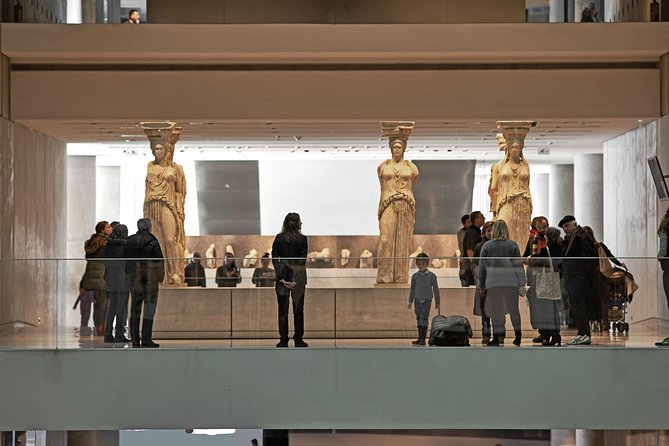
One of the smartest tips for a first visit is simple: on the third floor, there are two video presentations. If you watch them early, the rest of the museum makes more sense. Think of it like putting on the right glasses before you start examining details.
After that, don’t skip the area below the museum. The experience includes the underground archaeological site under the open-air pavilion beneath the museum. Even if you’re not obsessed with ruins, it’s the kind of place that gives you scale—how people lived, how discoveries connect to real structures, and why this museum exists in the first place.
If you only have about 90 minutes, you might feel torn between “keep listening” and “keep seeing.” I’d say do both: watch the third-floor videos, then spend time underground so you don’t finish the museum feeling like you only experienced the top layer.
Audio guide pacing: when it works brilliantly and when it won’t

This guide is built around multiple stops and stories (the experience is described with dozens of points of interest, often around 36–37 stops, and many unique story segments). That structure is a plus because it keeps you moving through the galleries without you needing to decide where to go next.
In the best scenario, the audio feels like a patient teacher: it gives you just enough context, then points your attention to what you’re looking at. In the less-perfect scenario, you might feel like some sections are more story than you want, especially if your style is reading plaques and scanning objects fast.
Here’s how to make the audio work for your personality:
- Use it as your main route, not as mandatory homework.
- If you hit a part you’re not enjoying, skip ahead and let your curiosity choose what matters.
- If you’re into myths and symbolism, the Parthenon stories are likely where you’ll get your money’s worth.
Also note the tour doesn’t include AR/VR or a live guide. So if you want a back-and-forth conversation, you’ll need a different kind of tour. This one is designed for headphones and self-direction.
Crowds, timing, and security: how to keep your visit calm

The Acropolis Museum can get crowded, and the experience includes the reality that you might still face queues at the entrance. The skip-the-line e-ticket helps with the entry portion, but once inside, you’re still visiting a popular site in a popular city.
One practical move: go earlier when you can. If you’re able to arrive near opening, you’ll often get that rare window when you can actually look at objects without feeling like you’re speed-walking through history.
Security is another timing factor. Avoid large bags and luggage. Keep it light so you don’t get slowed down in the check.
And one more thing: even with an offline map, it’s easy to get turned around in a museum with multiple floors and rooms. If that happens, slow down, find your bearings using the offline map, and resume your route. You’ll save time by not panicking.
Price and value: what $40.32 includes and why it can be fair
At $40.32 per person, you’re paying for more than admission. You’re also paying for:
- The admission ticket
- The prebooked e-ticket service
- The self-guided audio tour
- Offline content, including an offline interactive map
So the question isn’t just Is it expensive? It’s Is it useful for the way you want to visit? This is often a strong deal if you:
- want to skip the long lines at the ticket stage,
- like learning through audio rather than a live guide,
- and want a museum experience that you control.
If you already know you love reading plaques and hate audio, you might feel like you could’ve done it cheaper. But if you want context as you move—Athena, the procession, the myth scenes—then the audio layer is what makes the price make sense.
Who should book this self-guided Acropolis Museum ticket
This is a good fit if you’re:
- a first-time museum visitor who wants clear guidance on what you’re seeing,
- traveling with family (especially older kids who can handle a phone and headphones),
- short on time and want a structured route in about 1 hour 30 minutes,
- or allergic to rigid schedules and prefer to linger when something catches your eye.
It’s less ideal if:
- you hate phones and setup tasks,
- you need a live explanation on the spot,
- or you’re worried about the download process and don’t want to plan ahead.
Should you book the Acropolis Museum e-ticket and audio guide?
I’d book it if you want a smoother entry plus a story-led visit at your own pace. The combination of expedited entry and an offline audio tour with map is built for the real Athens museum experience: crowds, lots of floors, and the need for focus.
Skip it only if you’re sure you don’t want audio, or if you’re likely to arrive without the time (or phone compatibility) to get everything downloaded. This one rewards preparation.
If you’re flexible, charge your phone, download everything beforehand, use headphones, and plan to spend time both above and below. Then the Parthenon stories and the museum’s layout will click faster than you expect.
FAQ
Is the admission ticket included?
Yes. Your ticket includes the entrance fee/admission to the Acropolis Museum.
How long does the experience take?
It’s listed at about 1 hour 30 minutes (approx.).
Do I need an internet connection during the visit?
No. The audio tour includes offline content, including an offline interactive map. You can use the audio anytime online or offline.
Do I need a live guide?
No. This is a self-guided audio experience. No live guide is included.
Where do I meet, and where does it end?
Start and end is at the Acropolis Museum (Dionysiou Areopagitou 15, Athina 117 42, Greece). It ends back at the meeting point.
What do I need to bring?
You need your own smartphone and headphones. The experience does not include either.
Which phones are compatible with the audio tour?
It requires an Android or iOS smartphone. It is not compatible with Windows Phones, iPhone 5/5C or older, iPod Touch 5th generation or older, and iPad 4th generation or older, and iPad Mini 1st generation.
When should I download the app and audio?
Download the Clio Muse application and the audio tour before you go offline to avoid roaming charges. Also download your e-ticket as instructed in your email.
Is this purchase refundable or changeable?
No. The experience is non-refundable and cannot be changed for any reason.
Can I qualify for reduced or free admission?
Some reductions and free admission are listed for seniors (EU, 65+) and certain youth and children categories. Eligibility depends on ID and they may still need to wait in line.
You Might Also Enjoy




More Guided Tours in Athens
More Tickets in Athens



More Tour Reviews in Athens
- All Day Cruise -3 Islands to Agistri,Moni, Aegina with lunch and drinks included
★ 5.0 · 4,958 reviews