REVIEW · ATHENS
“All Day Tour Athens & Corinth:Highlights & Path of Apostle Paul”
Book on Viator →Operated by Greece Athens Taxi GAT · Bookable on Viator
A day that mixes Athens icons with Corinth’s Paul-linked sites sounds like a lot, but this tour keeps it organized. I like that it’s truly private for your group and that you get hotel/Airbnb or Port of Piraeus pickup and return, so the start is low-stress. You cover big-name stops in Athens (Acropolis, Parliament, Plaka) and then head to Corinth for the Temples of Apollo area and the archaeology that connects to the story of Apostle Paul.
One caution: you’re riding with an English-speaking driver who has history knowledge, but they’re not described as a licensed museum/site guide. If you want a certified guide to explain every museum hall, plan to request that in advance (availability can vary). Also, some days run shorter than the headline timing when the group needs shift around ticket lines, travel traffic, and the realities of a long route.
In This Review
- Key Things to Know Before You Go
- Why This Private Athens-and-Corinth Route Works in One Day
- The Acropolis Circuit: Parthenon, Erechtheion Karyatids, and the Theatre of Dionysus
- Small Temples, Big Atmosphere: Athena Nike and the Views from the Hill
- From Syntagma Square to the Parliament: Athens Politics in Plain Sight
- Panathenaic Stadium and Olympian Zeus: Marble That Still Feels Physical
- Plaka and Monastiraki: Where the Day Turns into Street-Level Athens
- Corinth Canal: The Strait That Shaped History
- Akrokorinthos and the Apostle Paul Trail: Temples, Theatres, and Early Christian Sites
- Archaeological Museum of Ancient Corinth: What €20 Buys You
- Tickets, Time, and the Driver-Guide Difference (Read This Part)
- Who This Athens-and-Corinth Tour Suits Best
- Should You Book This Tour?
- FAQ
- Is this tour private?
- How long is the tour?
- Does the price include pickup and drop-off?
- Are archaeological site entrance fees included?
- Does the tour include skip-the-line tickets?
- What language is the tour in?
- Do I have Wi-Fi and air-conditioning?
- Will there be a licensed tour guide inside museums?
- Can the pickup time be adjusted?
- What about cancellation?
Key Things to Know Before You Go
- Private-group pacing: your driver/van stays with your group, not a big bus herd.
- Transportation first, sites second: A/C Mercedes rides plus Wi‑Fi and chargers make the long day feel smoother.
- Entrance fees are extra: you’ll pay for Acropolis and the Archaeological Museum of Ancient Corinth separately.
- Skip-the-line help, not free entry: you get assistance buying skip-the-line tickets, but you still cover ticket costs.
- Athens + Corinth in one sweep: expect a packed route with quick stops and a few deeper looks.
- A driver with history knowledge: helpful context outside, but not a licensed guide inside every museum.
Why This Private Athens-and-Corinth Route Works in One Day
If your main goal is seeing the headline places fast—without spending your vacation time figuring out trains and meeting points—this style of day trip makes sense. You’re getting one organized vehicle for the long haul, plus pickup options that are convenient. That’s a big deal on a day that’s listed around 10 to 11 hours. Rome had its “one day at a time” energy. Athens and Corinth have their own rhythm: fewer straight lines, more stops, more stairs, and a lot of sun.
I also like that the tour is built around a clear story line: start with the political and artistic heart of ancient Athens, then shift to Corinth, where you’ll see areas tied to the early Christian world as well as the older religious sites. Even if you only remember a handful of names, you’ll still walk away with a sense of how the region fits together.
The practical part: this is not a “wander all day with no schedule” experience. It’s structured. Some stops are longer, some are quick. You’ll do better if you treat it as a highlights day, and you leave room afterward for your own pace in whichever neighborhood you like most.
You can also read our reviews of more tours and experiences in Athens
- All Day Cruise -3 Islands to Agistri,Moni, Aegina with lunch and drinks included
★ 5.0 · 4,958 reviews


The Acropolis Circuit: Parthenon, Erechtheion Karyatids, and the Theatre of Dionysus
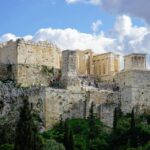
The day starts climbing—literally. The Acropolis sits high above Athens, so even the approach gives you that wow factor. You’ll hit the main monuments in an order that makes sense: you start with the big symbolic center, then move through the surrounding temples and theatrical spaces.
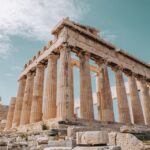
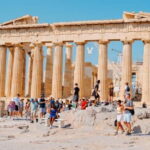
At the Parthenon, you’ll learn the essentials you can actually use: it’s dedicated to Athena, it began in 447 BC and was completed in 438 BC (with decorations continuing later). This isn’t just a photo stop. The structure is often treated like a single masterpiece, but it represents a whole system—how Athenian power got turned into stone, plus the Doric order taken to its classic form.
Then you’ll see the Erechtheion, known for the famous Karyatids. The difference here is tone. The Parthenon feels like the grand official statement. The Erechtheion feels more human—shaped by its position and by the role it played in the religious geography of the Acropolis.
I also like that the stop includes the Theatre of Dionysus and the Odeon of Herodes Atticus (Herodion) area. Athens is one of the few places where “entertainment” (theatre), politics, and public life are all written into the same hillside. If you’ve ever wondered why Greek tragedies feel so intense, being in the space helps. You’re not imagining scale. You’re seeing it.
Drawback to plan around: Acropolis time can be tight. The highlights matter, so you won’t get a slow, museum-style read of every column detail. If you love deep scholarly explanations, you’ll still get value, but you may want to return later for a longer Acropolis visit at your own pace.
Small Temples, Big Atmosphere: Athena Nike and the Views from the Hill
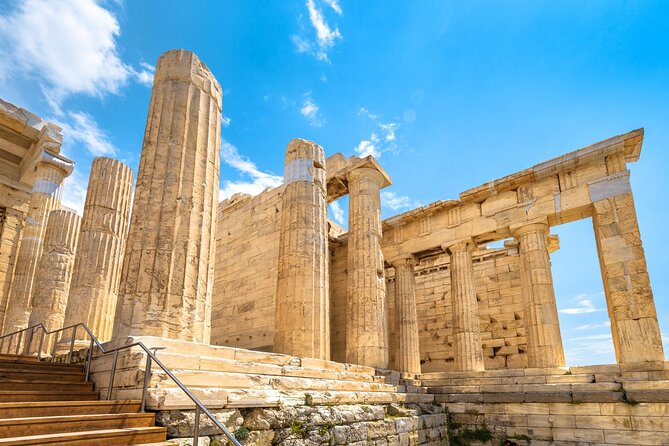
After the Parthenon and Erechtheion, the Acropolis route keeps revealing different sides of Athens. The Temple of Athena Nike is a good example. It’s not the biggest building you’ll see, but it ties together Athena’s role with the idea of victory and civic identity. Think of it as a piece of the larger puzzle rather than a standalone “main course.”
You’ll also get quick looks at the surrounding monumental layout—how the Acropolis works like a religious complex rather than one temple on a hill. And because you’re up high, the views do real work. Even on a day when you’re moving quickly, it’s hard not to pause for a minute just to orient yourself: you’re seeing where “the city” begins in the real world.
From Syntagma Square to the Parliament: Athens Politics in Plain Sight
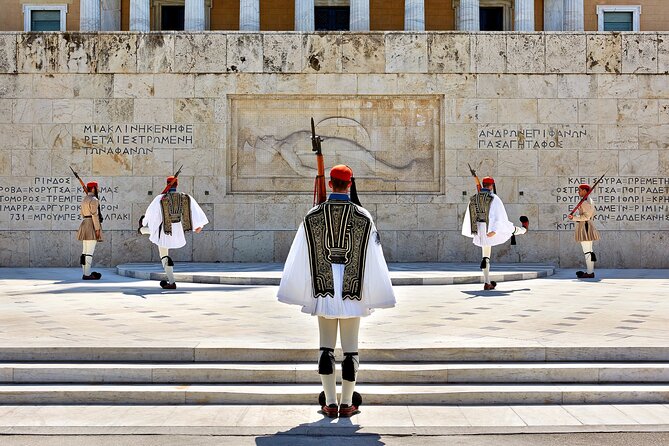
Once you head back down, the tour shifts from ancient religious power to modern political power. Syntagma Square is where you feel Athens as a living capital, not just a museum. The Hellenic Parliament sits in the old royal palace, and the Monument to the Unknown Soldier is right in front—guarded 24 hours a day.
One of the most practical reasons to include this stop: it’s easy to understand. You don’t need a lot of background reading to see what’s going on. The changing of the guard at the Euzones (the Presidential Guard) gives you a rhythm you can watch. Even if you don’t care about ceremony, it’s a reliable, short pause during a long day.
The National Garden (Royal Garden) is also worth a quick walk through or at least a slow look from the paths. It’s directly behind the Parliament area and includes older references and notable busts, so it breaks up the stone-and-heat feeling of the morning.
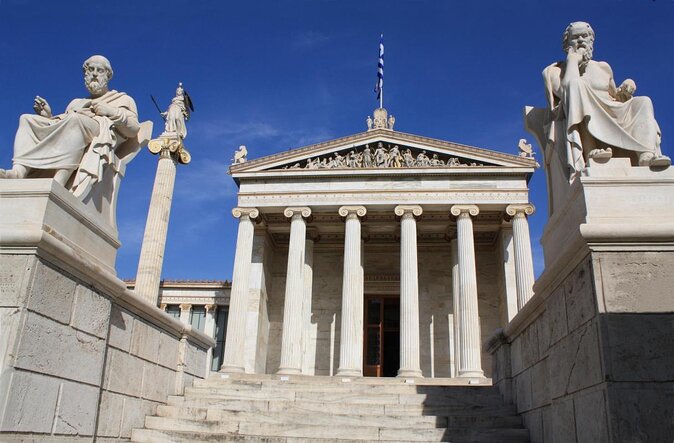
If you pass the National Library (Vallianeion) and see the University buildings and the Academy of Athens area, don’t rush it. These are the places where Athens shows its modern intellectual identity, and the architecture is part of the story too—neoclassical public buildings that echo the city’s habit of building institutions like monuments.
Panathenaic Stadium and Olympian Zeus: Marble That Still Feels Physical

Next you hit two “scale” tests: Panathenaic Stadium and the Temple of Olympian Zeus area.
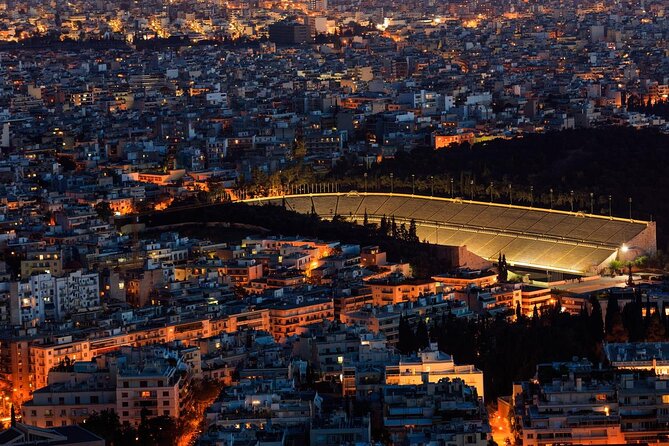
The stadium (the Kallimarmaro) matters because it’s not just historic; it’s built in a way that’s visually unmistakable. It’s described as the oldest stadium in operation that’s hosted Olympics three times, and it’s the only major stadium built entirely of white marble. You’ll feel why people photograph it from a few angles—marble makes the stadium look like a sculpture, but it’s also a real athletic space.
Then comes Olympian Zeus, a half-complete temple dedicated to Zeus. The point isn’t “fully preserved perfection.” It’s the scale plus the evidence of survival and destruction. The tall pillars and the setting help you see why this became a landmark for centuries: it’s the kind of ruin you can’t ignore, even if you’re only passing through quickly.
You’ll also catch Hadrian’s Arch and the Zappeion nearby. Those stops are short, but they create context: Athens isn’t only ancient Greek. It’s Roman, Ottoman-era layers, and modern governance all in the same walking radius.




Plaka and Monastiraki: Where the Day Turns into Street-Level Athens
After long monuments, I like the switch to neighborhoods. Plaka is described as the oldest and most charming area under the Acropolis, with winding alleyways, neoclassical houses, and red-tile roofs. This is your best chance to get some air into your day and reset your brain before the trip east to Corinth.
Plaka also gives you the chance to do something simple and valuable: sit. Even if it’s just a quick frappé stop, it helps you take in the details you might miss when you’re racing between sites.
Then you slide into the Monastiraki zone, where the old city feels like it’s pulling you along. You’ll see elements tied to the Ancient Agora and Hadrian’s Library, plus the Stoa of Attalos. Hadrian’s Library is notable for its internal courtyard and pool bordered by 100 columns—again, not just “a building,” but a whole public layout designed for gathering and learning.
A useful mindset here: the Agora was a city-state gathering place, a kind of social and political engine. So when you walk through the area, you’re not just looking at ruins. You’re trying to picture how people met, traded ideas, and made civic decisions.
Corinth Canal: The Strait That Shaped History
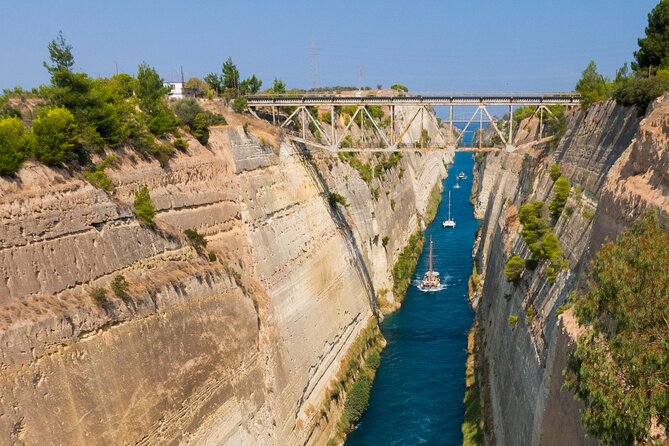
Corinth proper is a long day from Athens, but the route includes an in-between moment that helps you understand why Corinth mattered: the Corinth Canal and the strip of land called the Isthmus.
Even a short stop here gives you perspective. The canal connects the Saronic Gulf with the Gulf of Corinth, and the narrowness is the point. The tour also notes the strategic role of this zone, including the Hexamilion wall area that was preserved into Byzantine times. It’s a reminder that geography drives history more than we admit.
This is also one of the moments where you can take quick photos without feeling like you’re racing through the day. Use it to drink water, check your footing, and plan how you’ll pace the next hillside site.
Akrokorinthos and the Apostle Paul Trail: Temples, Theatres, and Early Christian Sites
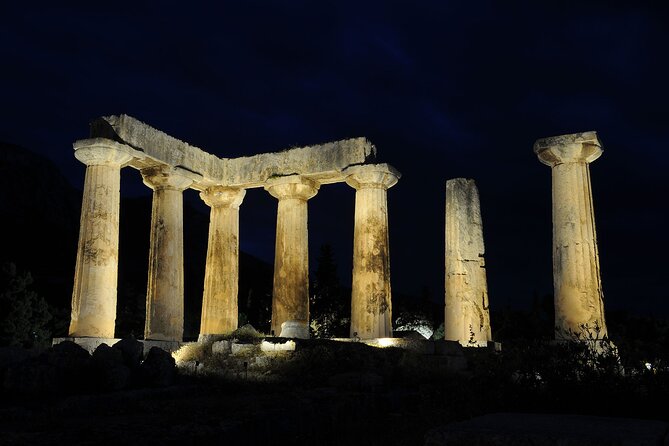
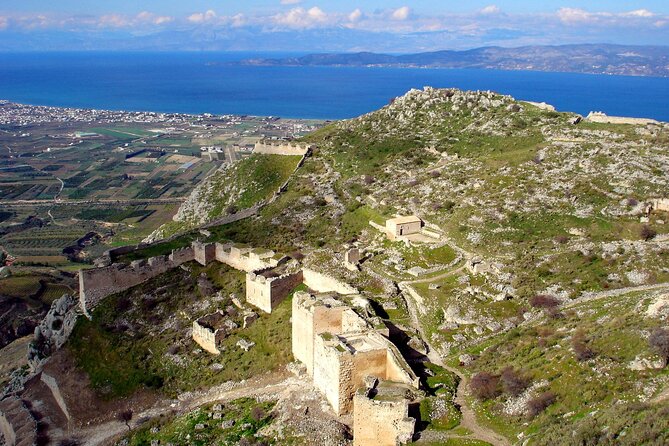
Then you climb again, but now it’s Corinth’s hilltop: Akrokorinthos. It’s a steep rock rising to about 575 meters above the surrounding area, described as an acropolis-style viewport used as protection against raids by land or sea.
Here’s why this stop feels special on this specific itinerary: the tour isn’t only about Greek temples. It includes the layers that came later. You’ll see a mix of older religious sites and later early Christian references.
On the hill list you’re given, you’ll encounter stops such as:
- Temple of Apollo
- Sanctuary of Asclepius
- Sanctuary of Demeter and Koris
- Apostle Paul’s step
- Theatre
- Early Christian Basilica of the Skull and Early Christian Basilica of Lechai
- Temple of Octavia
- Fountain Glavki
- plus other structures like a conservatory and early ruins tied to the site
I’d treat these as “chapters,” not a checklist. The older sanctuaries help you see the religious landscape of Corinth as it matured. Then the early Christian basilicas help you see how the story changes in later centuries.
The theatre also matters because it connects back to Athens. You’re seeing how entertainment and public life traveled across the Greek world, even when empires and religions changed.
Practical note: Akrokorinthos can feel exposed and uneven. Wear shoes you trust, and don’t assume the ground is uniform. Short stops are great, but your body will still pay the price if you’re dressed only for sightseeing sandals.
Archaeological Museum of Ancient Corinth: What €20 Buys You
At some point in the afternoon, you’ll end at the Archaeological Museum of Ancient Corinth. The museum was built in 1932 by the American School of Classical Studies, following excavations in the area. It’s a good place to catch up your understanding because it organizes what you saw outside.
The entrance is not included in the main price. The listing specifies the museum entrance fee as €20 per person. If you want value from your ticket, come in with one goal: match objects to the site you toured on the hill.
Highlights called out include prehistoric collections and finds connected to sites like the Asklepieion, covering from Geometric times through the Byzantine period. You’ll also see the Twin Kouroi from ancient Tenea, described as an example of archaic sculptural art.
One more angle: museums help you stop thinking in “ruins as pretty shapes.” They turn pieces back into evidence.
Tickets, Time, and the Driver-Guide Difference (Read This Part)
Here’s the most important value-and-planning reality: entrance fees are not included for the major sites. The Acropolis entrance is listed as €30 per person, and the Corinth museum entrance is listed as €20 per person. Skip-the-line help is included, but your ticket cost still comes from you.
So what are you paying for in the tour price?
- The private A/C Mercedes transportation
- The English-speaking driver with history context
- Help with timing via skip-the-line ticket purchasing assistance
- Comfort extras like Wi‑Fi, bottled water, and mobile chargers
- Pickup and drop-off without added charge (including Port of Piraeus)
About guides: the driver is described as having history knowledge but not a licensed tour guide to accompany you in sites/museums. A licensed tour guide may be available upon request, depending on availability. If you care about narration inside museums, message ahead and ask specifically.
Also plan around seasonal closures. The Acropolis and the Archaeological Museum of Ancient Corinth are listed as closed on dates like January 1st, March 25th, May 1st, Easter Sunday, and December 25th and 26th. If you’re traveling around those, double-check your dates so you don’t get stuck with “outdoor-only” substitutes.
Who This Athens-and-Corinth Tour Suits Best
This is a strong fit if you:
- want a one-day Athens + Corinth hit without navigating trains and multiple meeting points
- prefer a private vehicle for comfort and timing
- like broad historical framing, even if you’re not getting a museum-licensed guide inside every hall
- enjoy a route with both ancient and early Christian layers tied to Apostle Paul’s era
It’s less ideal if you:
- want a slow, ultra-detailed Acropolis museum experience with licensed narration
- hate being on a schedule for long stretches
- expect the exact day to match every listed duration down to the minute (traffic, ticket windows, and site flow can shift timing)
Should You Book This Tour?
I’d book it if you want value in logistics—pickup that actually helps, a comfortable ride, and a structured path through the big Athens and Corinth anchors. This kind of private day works well when you’re trying to see a lot but still keep your energy intact with A/C, water, chargers, and Wi‑Fi.
I would hesitate only if you’re the type who needs a licensed museum guide to walk you through every artifact and inscription, or if you’re traveling on a date near listed closures. If that’s you, request the licensed guide option early, and treat entrance fees as part of your total budget.
If you want, tell me your travel month and whether you’re starting from a hotel in Athens or from a cruise at Piraeus. I can help you sanity-check the timing and what to prioritize on a packed day.
FAQ
Is this tour private?
Yes. It’s described as a private tour/activity, and only your group will participate.
How long is the tour?
It’s listed at about 10 to 11 hours.
Does the price include pickup and drop-off?
Yes. Hotel/Airbnb/Port Piraeus pickup and drop-off are included without extra charge.
Are archaeological site entrance fees included?
No. Ticket prices for archaeological sites and museums are not included. The Acropolis is listed as €30 per person and the Archaeological Museum of Ancient Corinth is listed as €20 per person.
Does the tour include skip-the-line tickets?
There’s assistance with purchasing skip-the-line tickets, but the customer covers the ticket cost.
What language is the tour in?
It’s offered in English.
Do I have Wi-Fi and air-conditioning?
Yes. The vehicle includes A/C, Wi‑Fi on board, and bottled water, plus mobile chargers.
Will there be a licensed tour guide inside museums?
An English-speaking driver with history knowledge is included, but they are not described as a licensed tour guide inside sites or museums. A licensed tour guide may be available upon request, depending on availability.
Can the pickup time be adjusted?
Yes. Pickup times are flexible, and you can customize them.
What about cancellation?
Free cancellation is available up to 24 hours in advance for a full refund. After that cutoff, refunds are not available.
You Might Also Enjoy


More Full-Day in Athens
- All Day Cruise -3 Islands to Agistri,Moni, Aegina with lunch and drinks included
★ 5.0 · 4,958 reviews

More Tours in Athens


More Tour Reviews in Athens
- All Day Cruise -3 Islands to Agistri,Moni, Aegina with lunch and drinks included
★ 5.0 · 4,958 reviews