
REVIEW · ACROPOLIS OF ATHENS
Athens: Acropolis Ticket & Optional Self-Guided Audio Tours
Book on GetYourGuide →Operated by Key Tours · Bookable on GetYourGuide
The Acropolis becomes simple with a timed ticket. Choose your date and timeslot, get your pre-bought ticket by email, and head straight to the South Entrance to scan in. Add the self-guided audio tour and you’ll get clear commentary as you look at the Parthenon and other key monuments. One catch: the audio runs through a phone app, so you need headphones of your own.
I like that this is genuinely self-paced. You walk in on your own, scan at the validating machines, and take your time moving from one viewpoint to the next.
If you’re the type who hates wasted hours, the included optional Plaka audio tour is a nice extra. It helps you turn a single Acropolis visit into a fuller day of walking around Athens.
In This Review
- Key highlights to know before you go
- Timed entry at the Acropolis: fewer stress moments, more seeing
- Going straight to the South Entrance and scanning your ticket
- The Acropolis route you’ll actually care about
- Theater of Dionysus: the sound you can almost imagine
- Parthenon: the UNESCO symbol you’re finally facing
- Propylaea: the gate that turns movement into meaning
- Temple of Athena Nike and Erechtheion: details you’ll miss if you hurry
- Odeon of Herodes Atticus and top views: the panorama payoff
- Self-guided audio tour via your phone: how it works and what to expect
- Timing your visit: go early, then keep moving with breaks
- Packing and Acropolis rules that affect your day
- Value check: does $46 per person make sense?
- Who this fits best (and who should rethink it)
- Should you book this Acropolis ticket and audio?
- FAQ
- How do I get into the Acropolis with this ticket?
- Can I change my date or timeslot after booking?
- Do headphones come with the self-guided audio tour?
- What languages are available for the audio guide?
- What if I arrive late for my time slot?
- Are free admission options available for some visitors?
Key highlights to know before you go

- Timed entry you pick: your ticket is tied to the exact hour you choose, so you can plan the climb and the photos
- Walk in on your own: no group meeting point, no waiting for a guide, just scan and go
- Self-guided audio in multiple languages: English, German, French, Spanish, Italian, and more are available
- The classic Acropolis route: Theater of Dionysus, Parthenon, Propylaea, Temple of Athena Nike, Erechtheion, and big-picture views
- Optional bonus for later: an additional English self-guided audio tour for Athens Old Town (Plaka)
Timed entry at the Acropolis: fewer stress moments, more seeing

The real value here is the way the ticket works. Instead of arriving and gambling on how long it will take to get inside, you select a specific date and time window, and your admission is ready for that slot.
That matters at the Acropolis because the “waiting” time can eat your best hours. With a timed entry, you can plan around crowds and heat, and you get to spend your energy on the hill—not in queues. It also makes your day feel structured even though you’re exploring solo.
And yes, the Acropolis itself is still the star. This UNESCO World Heritage site stays instantly recognizable from any angle, and once you’re up there, the views over Athens really hit.
You can also read our reviews of more tours and experiences in Acropolis Of Athens


Going straight to the South Entrance and scanning your ticket

There’s no meet-up with a guide. You go directly to the Acropolis entrance, scan your ticket (printed or on your phone) at the validating machines, and enter during your selected time slot.
The key detail is where to aim: the ticket instructions direct you to the South Entrance, near the Acropolis metro station. That’s helpful because it reduces decision-making when you’re already thinking about logistics, directions, and shoes.
Once you’re in, you can go at your pace. You’re not trapped behind a large group, which is a big deal if you want time for:
- stopping for photos without feeling rushed
- slowing down at stairs and uneven ground
- spending extra minutes at the monuments that grab your attention
The Acropolis route you’ll actually care about

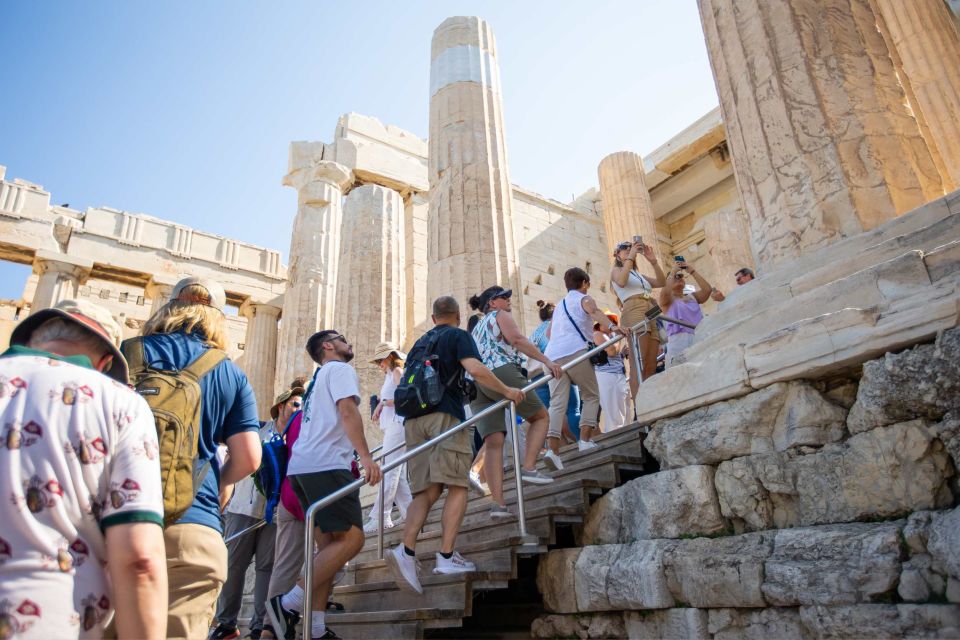
You can walk around the hill and see the monuments from multiple angles, including wide views toward the surrounding mountains and out toward the Aegean Sea. The site has enough “walk-and-pause” rhythm that a self-guided format feels natural.
A helpful way to think about the experience is as a chain of moments:
1) the theater and dramatic approach
2) the Parthenon zone (the main wow)
3) the gate-and-temple sequence around Propylaea and nearby structures
4) the top views that make everything feel connected
Theater of Dionysus: the sound you can almost imagine
One of the highlights is walking into the Theater of Dionysus. It’s one of those places where you feel the scale immediately, even before you reach the most famous temples.
In a self-guided setup, this stop works well because you can slow down and look across the seating area without worrying about keeping up. If your audio tour includes prompts tied to where you are, this is also a good spot to listen while you take in how the space was designed.
A practical note: you’ll be moving on stone steps and uneven surfaces. Comfortable shoes aren’t optional here.
Parthenon: the UNESCO symbol you’re finally facing
Next comes the heart of the Acropolis experience: the Parthenon and the area around it. You’ll be able to see the temple dedicated to Athena, the goddess of war, and understand why this site became a global icon.
What I like about approaching the Parthenon on foot from the lower areas is that it doesn’t feel like a “picture you came to copy.” It feels like a place with layers—platforms, sightlines, and architectural decisions that make more sense once you’re standing near the stones rather than studying them from a postcard.
Give yourself time here. People rush, but the best payoff comes when you let the monument and the surrounding views become one continuous scene.
You can also read our reviews of more guided tours in Acropolis Of Athens

Propylaea: the gate that turns movement into meaning
The route then takes you through Propylaea, the monumental gateway area. This is a stop where context matters, because it’s not only a building you look at—it’s also part of how the whole hill was organized.
In a self-guided audio format, Propylaea is a great moment to listen and then look again. You’ll likely find yourself shifting your angle to match what the commentary is describing, which makes the walk feel purposeful rather than random.
Temple of Athena Nike and Erechtheion: details you’ll miss if you hurry
Two more highlights sit near the middle-to-upper stretches: the Temple of Athena Nike and the Erechtheion. The Erechtheion is especially famous for its porch of maidens, and this is where the stonework goes from impressive to specific.
The advantage of self-guiding is simple: you can linger at the details. If you’re the type who likes to study carving, proportions, and how different parts of the complex relate, this is where your pace pays off.
Just remember the Acropolis is still outdoors with sun exposure and limited shade.
Odeon of Herodes Atticus and top views: the panorama payoff
From higher up, you can see the Odeon of Herodes Atticus from the top. That adds another layer to the experience because you’re not only looking at temples—you’re also connecting what you see up on the hill with the broader city below.
And then the views arrive in full: Athens spread out beneath you, with mountains in the distance and the sea in the far background. This is one of the few places in Athens where the geography feels like part of the story, not just a backdrop.
Self-guided audio tour via your phone: how it works and what to expect
If you choose the audio option, you’ll get a multilingual self-guided tour of the Acropolis and Parthenon. Languages listed include English, German, French, Spanish, Italian, plus Dutch, Polish, Japanese, and Portuguese.
A few practical points matter here:
- You’ll download the audio from the instructions sent with your ticket.
- The tour is accessed through an app.
- There is no physical audio device included.
The headphone requirement is the main “make it work” detail. If you show up without headphones, you can still enjoy the monuments, but you won’t get the added context that makes the visit easier to understand.
Also, the audio may use location to help guide you from stop to stop, and some recordings can prompt you as you move. Still, apps don’t always behave perfectly in busy areas. If the narration seems slightly off, don’t panic—just keep walking toward the next named monument area and let your eyes lead.
For me, the audio is most valuable in three moments:
- when you’re standing near the Parthenon and need clear orientation
- at Propylaea, where structure and movement matter
- at the Erechtheion, where the significance is easier once you know what you’re looking for
Timing your visit: go early, then keep moving with breaks

You have a 1-day ticket, and the experience is entirely about timing once you’re on the hill. Admission closes at different times depending on the season, so you’ll want to check your date.
The closing times are listed by period:
- April 1 to September 15: 7:30 PM
- September 16 to September 30: 7:00 PM
- October 1 to October 15: 6:30 PM
- October 16 to October 31: 6:00 PM
- November 1 to March 31: 5:00 PM
Even with a timed entry, you’ll feel the crowds later in the day. The best strategy is to select an early timeslot and plan to arrive with enough buffer to settle in.
Why early helps:
- fewer lines at entry
- more breathing room for photos
- less time baking in the sun
In hot months, the climb up the hill is noticeable. It’s not just walking across a flat museum floor. It’s steps, incline, and lots of open sun, so your pace needs to reflect the weather.
Bring water and don’t treat this as a quick stop. Give yourself time to enjoy the views, not just race to the Parthenon.
Packing and Acropolis rules that affect your day

The practical stuff is what saves you friction. Here’s what you should bring:
- comfortable shoes (stairs and stone can be slippery)
- sunglasses and a sun hat
- water
- headphones (for the audio app)
- a passport or ID card for children
And here are the clear “don’t bring it” rules:
- no pets
- no baby strollers
- no luggage or large bags
- no backpacks
- no alcohol or drugs
These restrictions change how you travel. If you’re used to carrying a daypack, plan to travel light. Having fewer items makes scanning and moving much faster.
Value check: does $46 per person make sense?

At $46 per person, the question isn’t just whether you’re paying for entry. You’re also paying for a timed, pre-bought ticket that reduces the biggest hassle at the Acropolis: getting in when crowds are intense.
Plus, the audio option (when selected) adds real value because it gives you an English/European-language guided layer without the cost of a live guide. If you like knowing what you’re looking at while you walk, the audio can turn the Acropolis from a “wow” visit into a “now I understand it” visit.
If you’re traveling with limited time in Athens, this setup also tends to be a good use of money. You’re not losing half a day to logistics. You can pick your hour, get in, and spend the day on the hill.
One more value angle: the optional Athens Old Town (Plaka) English self-guided audio tour can help you extend the day after your Acropolis climb. You go from monuments to neighborhood streets without needing extra planning.
Who this fits best (and who should rethink it)

This is a strong match if you:
- want freedom to move at your own pace
- care about context (and will use the audio app)
- like planning around crowds by choosing your timeslot
- prefer walking over group logistics
It may be a tougher fit if you:
- are pregnant, or
- need wheelchair access (the experience notes it’s not suitable for wheelchair users)
That doesn’t mean you can’t visit the Acropolis at all. It just means this specific format and route are likely to feel difficult for certain mobility situations.
Should you book this Acropolis ticket and audio?

Book it if you want a clean, low-stress way into the Acropolis and you’re happy to use your phone plus headphones for the audio. The timed entry is the real deal here, especially if you’re visiting during peak periods or you’re trying to protect your best hours for photos and viewpoints.
Skip it (or at least reconsider the audio add-on) if you hate app-based experiences or you’re unlikely to use headphones. In that case, you’d still see the Acropolis, but you’d lose the strongest “value lever” that helps you connect the monuments as you walk.
FAQ
How do I get into the Acropolis with this ticket?
You go directly to the Acropolis entrance, scan your ticket (printed or on your phone) at the validating machines, and enter on your own during your selected time window.
Can I change my date or timeslot after booking?
No. The travel date and/or entry time slot cannot be amended for any reason.
Do headphones come with the self-guided audio tour?
No. Headphones are not included, and there is also no physical audio device provided. You’ll need headphones to listen to the app.
What languages are available for the audio guide?
The audio guide is available in English, Spanish, French, German, Italian, Dutch, Polish, Japanese, and Portuguese.
What if I arrive late for my time slot?
Entry is allowed only during your selected time slot, or within 15 minutes before or after it. If you’re outside that window, entry won’t be permitted.
Are free admission options available for some visitors?
Yes. From April 1, 2025, EU citizens under 25 and non-EU citizens under 18 are entitled to free admission with valid ID, but onsite free ticket availability for your preferred time slot cannot be guaranteed.