REVIEW · ATHENS
An exciting exploration of Peloponnese at ancient Corinth, Mycenae and Nafplio
Book on Viator →Operated by Athens Tours Greece · Bookable on Viator
Ancient Corinth to Nafplio in one day is a smart squeeze. This private outing is built for people with limited time in mainland Greece who still want the big names—Ancient Corinth, Mycenae, and Nafplio—without the hassle of public transport.
I particularly like the logic of the route: punctual, air-conditioned driving that gets you from stop to stop efficiently. I also like that it’s truly private, up to 3 people, so the day feels less like a bus ride and more like a custom plan.
The one catch is pacing: with only a few hours at each major site, you’ll need to focus your priorities. Entrance fees aren’t included, so budget extra and plan ahead for ticket availability.
In This Review
- Key highlights you’ll feel during the day
- Why this Athens-to-Peloponnese day works when time is tight
- From Piraeus or your hotel: the start matters more than you think
- Corinth Canal in 55 minutes: what to do with the time
- Ancient Corinth: a trade crossroads you can still picture
- Mycenae and Agamemnon: how to handle 1 hour 55 minutes
- Nafplio: lunch, strolls, and the town that feels like a reward
- Driving through Attica and the Peloponnese: the value of context on the road
- Driver role, tickets, and how to avoid the common hassles
- Price and value: what $504.10 gets you (and what it doesn’t)
- Who should book this Peloponnese day—and who might skip it
- Should you book it?
- FAQ
- What’s included in the tour price?
- Are entrance fees to Ancient Corinth and Mycenae included?
- Do you pick up cruise ships in Piraeus?
- How long is the tour?
- Is this a private tour or shared group?
- Can I customize the tour?
- Can the driver guide inside archaeological sites?
Key highlights you’ll feel during the day
- Private, small-group format (up to 3) for a calmer experience than shared day tours
- Cruise-ship and hotel pickup at the same key Athens starting points (Piraeus or your hotel)
- Corinth Canal photo stop with enough time to actually stop and look, not just pass by
- Big-ticket archaeology, short-and-sweet: Ancient Corinth and Mycenae are both on the schedule
- Nafplio time for lunch and strolls in a town with very walkable streets
- Driver guidance for the drive, with history connected to what you’ll see next (then you explore on-site)
Why this Athens-to-Peloponnese day works when time is tight
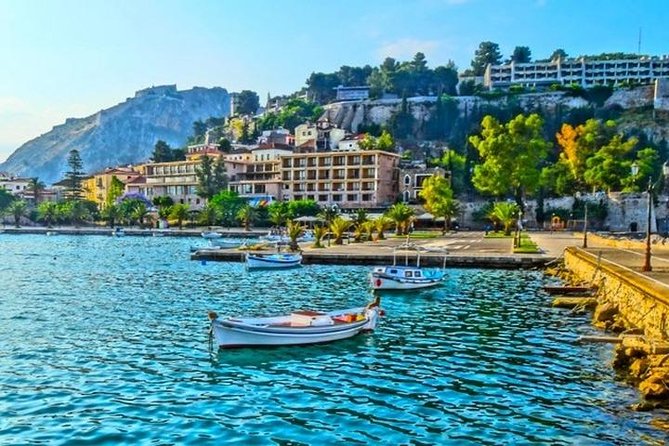
If you only have one shot at the Peloponnese from Athens, this kind of plan makes sense. You get the full arc: a dramatic modern landmark (Corinth Canal), then two of Greece’s heavy hitters (Ancient Corinth and Mycenae), then a pleasant finish in Nafplio.
What you’re really paying for is time and comfort. The day moves on a schedule, not a “maybe later” vibe. You’re in an air-conditioned vehicle appropriate for your group size, and you don’t have to coordinate buses, trains, or taxi hopping between the sites.
Also, this is the sort of itinerary that can turn into chaos if you do it yourself. With this setup, you’re not guessing parking, you’re not wrestling with routes, and you’re not paying for extra time just to get from one “must-see” to the next. It’s efficient without feeling like a sprint, as long as you go in with realistic expectations about how much you can absorb at each archaeological stop.
One more practical win: you’ll have a mobile ticket included. That means less paper to manage while you’re moving between places.
You can also read our reviews of more tours and experiences in Athens.



From Piraeus or your hotel: the start matters more than you think
Pickup is one of the biggest stress-reducers on this tour. If you’re on a cruise, you’ll disembark and walk outside the terminal exit door, where the driver is waiting with a sign showing your name. If you’re in Athens, you meet at the main entrance of your hotel—just let the porter or receptionist know you expect the driver.
This matters because timing in Athens can go sideways. Getting picked up correctly at the start means you’re not burning time searching for a car, translating directions, or waiting on wrong entrances. Since the itinerary is packed, those minutes count.
You’ll then head toward the Acropolis area. The plan includes a stop to admire the Temple of Democracy and to get that classic Athens view before you switch gears and head south. Even if you’ve seen Athens from photos, I like having this “bridge moment” at the beginning. It helps you mentally set context: you start in the birthplace of modern civic ideas, then you move into the civilizations that fed the Mediterranean long before modern states existed.
As you drive through Attica, you also get the “why this place matters” framing. Attica is described as a 6,000-year journey that shaped what many people call western civilization—so you’re not just sightseeing; you’re building a thread between eras while the scenery rolls by.
Corinth Canal in 55 minutes: what to do with the time
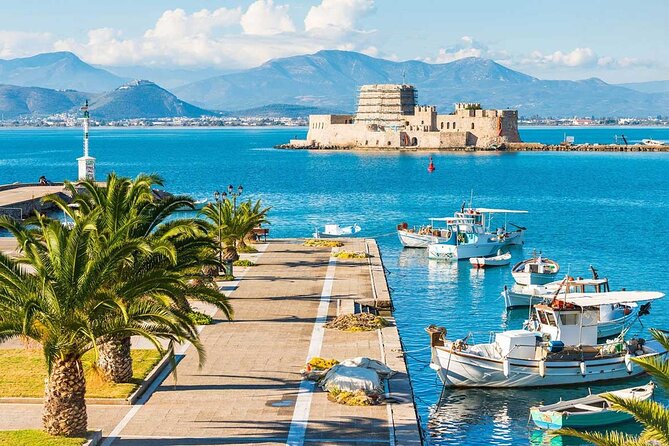
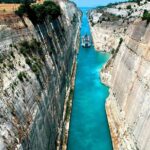
Your first major Peloponnese stop is the Corinth Canal, reached by a coastal drive along the Saronic Gulf. This is one of those locations that feels instantly dramatic because of how narrow the passage is compared to the surrounding geography.
Here are the facts you’ll want to know while you’re there:
- The canal is 6.4 kilometers long
- It’s only about 25 meters wide
- It connects the Gulf of Corinth to the Saronic Gulf, making the Peloponnese feel like it’s been turned into an “island” by water
- It was a long-held dream—the project was executed in the late 19th century, but the idea goes back about 2,000 years
- The canal ties into Corinth’s old shipping logic: before it existed, ships effectively had to go around the Peloponnese, adding a long detour
There’s also a neat historical detail that helps the place click: the mention of Periander, tyrant of Corinth, and the earlier diolkós (a stone road used to move ships overland on wheeled platforms). If you understand that, the canal stops being just scenery and becomes a “problem solved” in engineering history.
You get about 55 minutes, which is enough time to:
- take photos without rushing
- orient yourself to the waterway’s direction
- get a quick sense of how a passage like this changes trade routes
Admission is listed as free here, which is another good value moment in the schedule.
Ancient Corinth: a trade crossroads you can still picture
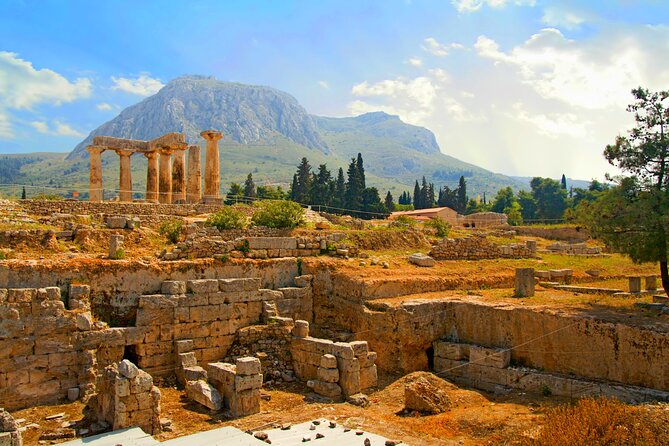
After the canal, you drive about 20 minutes to Ancient Corinth (Archaia Korinthos). You’ll spend around 1 hour 20 minutes on-site, and that’s the right length if you use it strategically.
Ancient Corinth matters because of its geography. It’s described as having fertile soil plus a strategic location at the intersection of:
- land routes from the Balkan region toward the Peloponnese
- waterways connecting the western Mediterranean to the east (Asia Minor and Syria-Palestine)
That intersection helped Corinth grow early and expand through trade. It’s also why you see historical momentum: Corinthian colonies were founded in the 8th century BC, including places like Corfu and Syracuse, which played real roles in shaping the ancient Mediterranean.
Here’s the best way to make the time count:
- Focus on the layout and the idea of movement—where people and goods would have gone
- If there’s signage explaining major structures, read it fast and then look again with that info in mind
- Don’t try to “collect every fact.” Ancient sites are big. Your goal is to leave with a mental map of how Corinth functioned
Admission fees aren’t included for this stop, so you’ll want to plan for that cost (and ideally pre-purchase).
Mycenae and Agamemnon: how to handle 1 hour 55 minutes
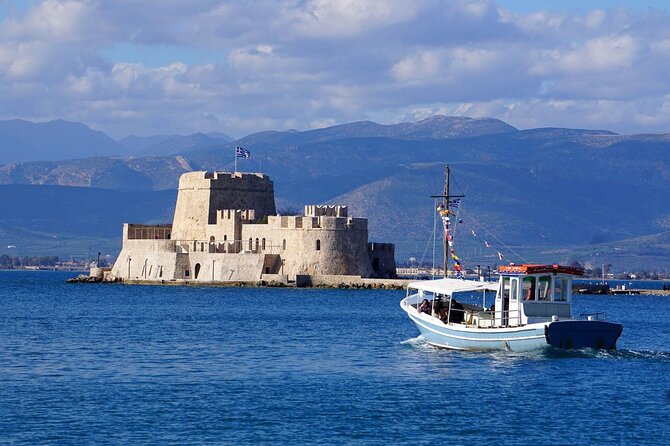
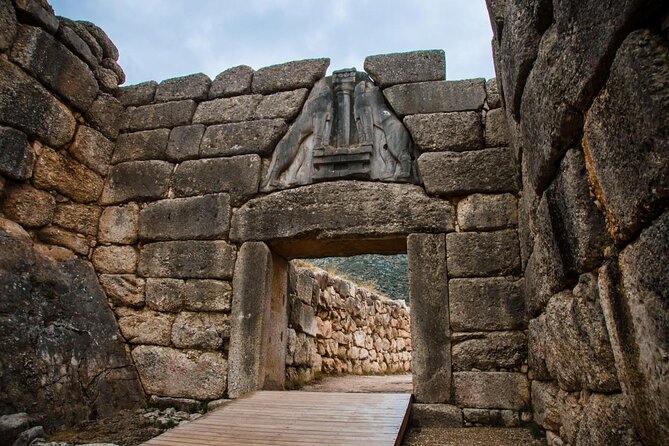
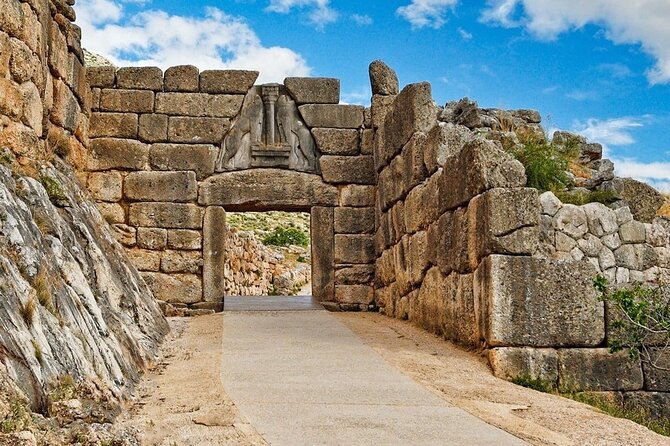
Next comes Mycenae, reached by about 35 minutes of driving. This is one of the most myth-and-archaeology places in Greece. The theme is “Rich in Gold,” tied to the kingdom of mythical Agamemnon, made famous through Homeric epics and later literature.
Mycenae is also described as the most important and richest palatial center of the Late Bronze Age in Greece. That’s a big deal because palaces weren’t just homes—they were administrative hubs. If you think of Mycenae as a power center, everything tends to feel more logical.
You’ll spend about 1 hour 55 minutes here, and that’s a generous window compared to many “big day” schedules. Since admission fees are not included, it’s worth arriving with a couple of mental anchors:
- Mycenae = a palace-centered society
- The name “Mycenae” connects to myth through Perseus and the idea of gold-rich rule
- The myths aren’t the point instead of the archaeology; they’re the doorway that helps you read the site
The tour description includes a myth detail about Perseus and the naming story tied to the pommel (mykes) of his sword, plus Pausanias’s account involving a spring and a mushroom root. You don’t need to memorize it, but having a story like that in your head can make the stones feel less random and more purposeful.
Physical note: you should have moderate physical fitness for walking on uneven terrain typical of archaeological sites. If you’re comfortable with that, the time here is likely to feel satisfying rather than rushed.
- All Day Cruise -3 Islands to Agistri,Moni, Aegina with lunch and drinks included
★ 5.0 · 4,958 reviews



Nafplio: lunch, strolls, and the town that feels like a reward
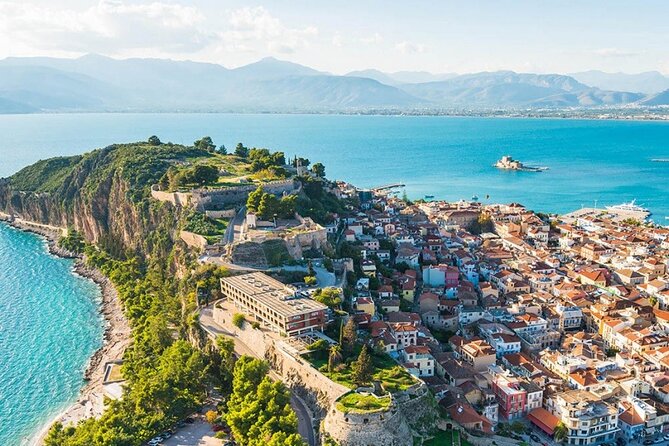
After Mycenae, you head to Nafplio in about 20 minutes. This is where the day softens. You have around 1 hour 30 minutes—long enough for food and a walk, short enough that you won’t get stuck waiting for the bus back.
The description calls Nafplio one of the most beautiful towns in the Argolis area and one of the most romantic cities in Greece. It was the first capital of the newly born Greek state between 1823 and 1834, which explains why you’ll see layers beyond the ancient world: prehistoric involvement (Argonautic expedition and the Trojan War are mentioned in the local tradition), Roman decline, Byzantine flourishing, and then Frankish and Venetian influence.
Architecturally, it’s described as a mix of ancient walls, medieval castles, monuments, and Venetian or neoclassical buildings. Even if you only skim the sights, that blend gives you that “this place has survived” feeling.
Lunch is possible here, but food isn’t included. In practical terms, this is your chance to refuel without losing the afternoon pace. If you want a smoother lunch, I’d choose a spot close to where you’re walking, not one across town, because your time is limited.
Tip: since you’ll likely be standing and walking after two archaeology stops, Nafplio is also a good moment to slow down and take photos without thinking about the next queue.
Driving through Attica and the Peloponnese: the value of context on the road
A lot of day tours drop you at each stop and then expect you to figure out the story on your own. This one tries to do the connecting work while you’re in transit.
The route includes the coastal drive along the Saronic Gulf, and the Peloponnese is framed through its wine region identity—Peloponnese Wine Roads and native grapes like Moschofilero-Mantinia, Agiorgitiko-Nemea, and Mavrodafni (often linked to dessert wines). You’re not shown a vineyard tasting on this specific schedule, but the context helps you understand why people talk about this region as something more than “ruins and ruins.”
Attica also gets treated as more than Athens overflow. It’s positioned as a place where arts, monuments, and festivals spanning eras shaped culture over 6,000 years. That’s helpful if you like understanding what you’re looking at rather than only getting dates.
And on the practical side, the vehicle is air-conditioned, which sounds basic until you do the Peloponnese in warmer months and realize comfort affects your mood more than you’d expect.
Driver role, tickets, and how to avoid the common hassles
This tour is private, but it has a real-world limitation: the driver is not licensed to accompany you inside archaeological sites and museums. The driver can guide you up to the point where you enter, with history and cultural framing during the drive. Once you’re inside, you’ll explore on-site.
The operator says licensed English-speaking guides can be arranged for an extra cost (subject to availability). That’s useful if you want a deeper, inside-the-walls explanation at Ancient Corinth or Mycenae. If you’re comfortable reading signage and going at your own pace, you might not need that add-on.
Two other practical notes matter:
- Entrance fees aren’t included, and you’re also advised to have admission tickets pre-purchased because availability can be limited. You can request tickets to be bought in advance under a small service fee.
- You should keep an eye on what you pack: water, sun protection, and comfortable shoes. The tour includes transportation and pickup/drop-off, but it does not include food and drinks.
One of the best signs from the experience feedback is how smooth the logistics can be. In one standout account, the driver was described as super friendly and helpful, and the communication was easy when people needed adjustments to pick-up or drop-off. That’s exactly what you want on a day where timing is tight.
Price and value: what $504.10 gets you (and what it doesn’t)
The price is listed as $504.10 per group (up to 3) for about 8 hours. That makes it easy to compare to shared tours.
If you have 2–3 people, this can be strong value because you’re essentially splitting the cost of:
- private vehicle time
- direct pickup/drop-off (including the cruise-ship flow at Piraeus)
- driver service and on-the-road narration
If you’re just one person, the cost is higher than a shared option, and you’ll feel the premium more. But if you care about flexibility and hate waiting for strangers, private still often wins.
What you should not forget: the biggest variable costs are entrance fees and any optional licensed guide request inside sites. Also, lunch is not included, so your “all-in” budget depends on what you choose in Nafplio.
So the value formula is simple:
- Great value when you have 2–3 people and want comfort plus efficiency
- Less value if you’re traveling alone and are fine piecing everything together yourself
Who should book this Peloponnese day—and who might skip it
Book this if:
- you want a one-day mainland Greece plan that hits Ancient Corinth, Mycenae, and Nafplio
- you’re traveling with a small group and prefer privacy
- you care about getting context during the drives, not just standing in ruins hoping everything makes sense
- you’re on a cruise and need a straightforward way to reach the Peloponnese from Piraeus
Skip it (or consider another format) if:
- you want lots of time at each site for slow, in-depth exploration
- you strongly prefer a full inside-the-site guide at every stop (since the driver can’t do that licensing role)
- you hate ticket pre-planning, because entrance fees are not included and ticket availability can be an issue
Should you book it?
I think it’s a smart booking for people with limited time who still want the classic Peloponnese lineup. The route is efficient, the setup is private, and you start with a meaningful Athens/Acropolis moment before switching fully into the Peloponnese story. The only reason not to book is if you’re the type who needs long hours at museums and archaeological sites—this schedule is built for focused viewing, not lingering all day.
If that matches your travel style, this tour is an easy yes.
FAQ
What’s included in the tour price?
You get a professional English-speaking tour driver, private transportation in an air-conditioned vehicle sized for your group, hotel pickup and drop-off in Athens, and cruise ship pickup/drop-off at Port of Piraeus. The tour is private (up to 3 people) and you’ll have a mobile ticket.
Are entrance fees to Ancient Corinth and Mycenae included?
No. Entrance fees to archaeological sites and museums are not included, so you’ll need to budget for those tickets separately.
Do you pick up cruise ships in Piraeus?
Yes. The meeting point for cruise passengers is outside the terminal exit door, where the driver/guide is waiting with a sign with your name.
How long is the tour?
The duration is listed as about 8 hours.
Is this a private tour or shared group?
This is a private tour/activity. Only your group participates, and the group size is up to 3.
Can I customize the tour?
Yes. Travelers can customize the tour within the itinerary.
Can the driver guide inside archaeological sites?
The driver can guide you until you enter archaeological sites and museums, but drivers are not licensed to accompany you inside. If you want a licensed English-speaking guide for inside the sites, it can be arranged for an extra cost (subject to availability).
You Might Also Enjoy


More Tour Reviews in Athens
- All Day Cruise -3 Islands to Agistri,Moni, Aegina with lunch and drinks included
★ 5.0 · 4,958 reviews